Overview
People often call the issue a paint problem. Sometimes it is.
Occasionally the court needs more than paint.
Professional pickleball court painting begins with finding out which one is true.
Quality & Heritage Court Services paints and recoats pickleball courts for homeowners, schools, clubs, HOAs, hotels, communities, municipalities, and commercial properties. We clean and prepare the surface, make the repairs included in the project, apply acrylic color coatings, and mark the court accurately.
The goal is not simply to make an old court brighter. It is to bring back clear lines, dependable footing, better ball visibility, and a surface people look forward to playing on.
If your court has faded, become slippery, or started showing every old repair, contact our team. We can inspect it and tell you whether repainting will be enough.
Court Paint Has a Job Beyond Looking Good
Pickleball puts a surprising amount of action into a small area.
Players hurry toward the kitchen, stop abruptly, move sideways, retreat, and step forward again. Certain parts of the surface see the same footwork hundreds of times in a single week. That wear is quite different from what happens on a patio or driveway.
This is why ordinary outdoor paint does not belong on a pickleball court.
Acrylic court coatings contain carefully selected aggregate that gives the surface texture. That texture helps players feel secure as they change direction. It also affects how the ball meets the ground.
The coating needs balance. If it is too smooth, the court may feel uncertain when it collects dust or moisture. If it is too rough, falls become harsher and pickleballs may wear more quickly.
According to USA Pickleball’s court surfacing guidance , 100 percent acrylic coatings are recommended for pickleball surfaces. When correctly applied, these coatings allow some vapor transmission and provide texture for traction and ball response.
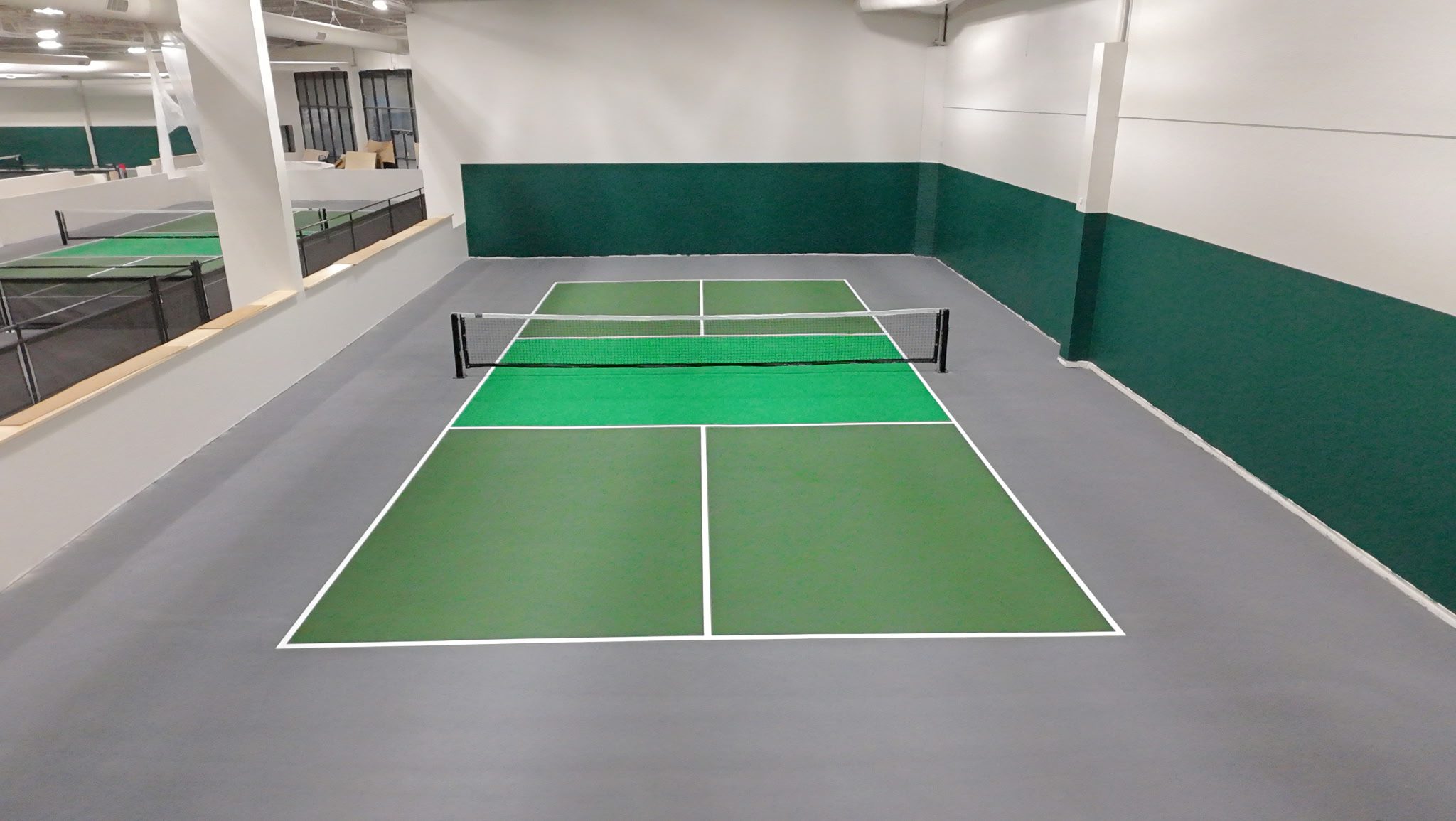
Fresh coating can also make the court easier to read. Players should be able to pick out the kitchen, sidelines, baseline, and service areas without thinking about them. Good color contrast helps those parts register immediately, even when the rally gets fast.
Does the Court Need New Color or More Extensive Work?
A court does not need to look ruined before it deserves attention.
Sometimes the first clue comes from regular players. They mention that one area feels slick. They start questioning whether a line is in or out because the edge has faded. The ball becomes harder to track against a washed-out background.
Other warning signs are easier to spot:
- The surface looks pale or patchy
- Court lines have lost their sharp edges
- Old repairs stand out against the surrounding color
- The kitchen and service areas are hard to distinguish
- The coating is peeling or flaking
- Water remains in certain areas after the rest of the court dries
- The court feels smoother near the baseline or kitchen
- The property has been renovated, making the court look neglected by comparison
Fading alone may call for cleaning, preparation, and fresh acrylic coats. Peeling, standing water, widespread cracking, or pavement movement points to a larger issue.
New color cannot level a low spot. It cannot stop a moving crack. It cannot make loose coating stick to the pavement underneath.
Quality & Heritage Court Services looks at the whole surface before recommending pickleball court repainting. If repairs or resurfacing are needed, they should be handled before the finish coats go down.
Our court maintenance and resurfacing services can be included when the project needs more than color and new lines.
Why Preparation Takes So Much of the Time
The painting itself is often the most visible part of the project. Preparation is what helps it last.
Acrylic coating does not bond well to dirt, loose material, oil, algae, or flaking paint. If those are left behind, the new layer may blister, peel, or wear unevenly.
We begin by cleaning the court and removing loose contamination. The exact method depends on what is on the surface and how firmly the existing coating is attached.
Then come the repairs.
A narrow, stable crack may need a relatively straightforward treatment. A crack that keeps widening is a different matter. A shallow worn spot needs different preparation from a depression that collects water.
Previous repairs also need a closer look. Some have hard edges that may remain visible beneath the new color. Others have begun separating from the surrounding pavement.
This is not the glamorous part of pickleball court painting, but it is the part that prevents the finished court from looking good for one season and disappointing the next.
Choosing Colors That Work During a Game
There is no rule saying every pickleball court has to be blue and green.
Those colors are popular because they often provide useful contrast, but they are not the only workable choice. Gray, red, tan, purple, and other shades can be used when they suit the property and preserve visibility.
The trick is to choose colors as a player, not only as a property owner.
A combination may look beautiful on a small sample and feel very different across an entire outdoor court. Strong Texas sunlight can make bright shades more intense. Dark colors may hold more heat. A color that works well with a yellow ball may offer less contrast with a bright green or orange one.
The surrounding property changes the effect too. Dark fencing, pale concrete, red brick, heavy landscaping, or a neighboring pool can all influence how the finished palette looks.
One Color Across the Playing Area
A single playing color creates a quiet, uncluttered court. The lines do most of the visual work.
This approach can suit private homes where the owner wants the court to settle into the landscape rather than become the loudest feature in the yard.
A Contrasting Kitchen
Using a second color for the kitchen makes the non-volley zone easier to recognize. It also gives the court more character without changing the actual layout.
The contrast can be bold or restrained. Two related shades may be enough to separate the area without making the surface feel busy.
A Different Color Outside the Lines
Painting the perimeter in another shade frames the playing area. It gives players a clear sense of where the court ends and the run-off space begins.
This can be especially useful on larger surfaces or commercial properties where several courts sit next to one another.
School Colors, Club Colors, and Logos
A school, club, hotel, or HOA may want the court to reflect its identity. That can work well, provided the final combination still helps players see the ball and lines.
Some colors that look excellent in a logo do not work as well across thousands of square feet of pavement. We help owners adjust the balance before the material is ordered and applied.
Logos can also be included in agreed locations where they will not make the playing area confusing.
Clear Lines Matter More Than People Expect
A pickleball court is not complicated to look at. That simplicity makes mistakes stand out.
A line that is slightly crooked or a kitchen that is a few inches off will be noticed. So will fuzzy edges, inconsistent width, drips, and old markings showing through beneath the new layout.
The 2026 USA Pickleball Official Rulebook sets the standard court at 20 feet wide and 44 feet long for singles and doubles. Court lines should be 2 inches wide, uniform in color, and clearly different from the surface.
Measurements are taken to the outside edge of the lines. That last detail is important. Measuring to the middle or inside edge changes the size of the playing area.
A standard layout includes:
- Two sidelines
- Two baselines
- A centerline on each side of the net
- Non-volley zone lines 7 feet from the net
- Right and left service areas
Before painting, the layout is measured, checked, and taped. The line coating is then applied carefully so the finished edges remain clean.
If an old court was marked incorrectly, repainting may be the right time to correct it. Existing lines sometimes need additional preparation so they do not show through the new colors.
Dedicated Pickleball Courts Are Easier to Read
A dedicated court has one set of markings and one clear purpose.
No tennis lines cross the kitchen, and basketball markings don't cut through the service area. Players can see the relevant boundaries immediately.
When repainting a dedicated court, owners may decide to keep the original palette or change it completely. The kitchen color can be separated. The perimeter can be softened or darkened. Faded lines can be corrected, and worn areas can be brought back into the same finish as the rest of the surface.
If the pavement remains sound, this work can dramatically change the court without rebuilding it.
Property owners starting from an undeveloped space can learn more about our pickleball court construction and installation services.
What If the Surface Is Used for More Than Pickleball?
Many schools, communities, and homes use one area for several activities.
Adding pickleball lines to an existing tennis or basketball surface can make practical sense. It can also leave the floor looking like a diagram if every marking receives the same visual weight.
Blended lines should be easy to identify without overpowering the primary layout. A quieter color often works better than another set of bright white markings.
Before adding them, we look at:
- The condition of the existing coating
- Current line colors
- Available space beyond the pickleball boundaries
- Net location
- Nearby fencing, walls, posts, and equipment
- Which activity uses the surface most often
- Whether the old court needs recoating first
The marked pickleball area measures 20 feet by 44 feet, but players need room beyond those lines. A court fitted tightly between obstructions may meet the painted dimensions and still feel uncomfortable to use.
Net choice matters too. Some shared areas use a portable system, while others install permanent posts. That decision should be settled before final line placement.
How Pickleball Court Painting Is Completed
Every court arrives with a different history. Some have been cleaned and maintained regularly. Others have collected years of patched cracks, fading, mildew, and improvised line work.
The process changes with the surface, but the basic order remains the same.
First, We Walk the Court
We look at more than the color.
The inspection includes cracks, low spots, peeling areas, previous repairs, drainage, line accuracy, edges, net posts, and places where water or dirt enters from the surrounding property.
We also ask how the court is used. A private family court has a different routine from a busy community facility. That affects color choices, expected wear, and the amount of preparation that makes sense.
Next Comes Cleaning and Repair
Loose dirt, leaves, organic growth, and failing material need to be removed. Cracks and damaged areas included within the scope are repaired.
If water settles in a depression, the area may need leveling. If the old coating is loose, painting over it is not an acceptable shortcut.
No repair method can promise that an active structural crack will never return. What matters is understanding the limitation and using an appropriate treatment rather than hiding the line with color.
Then We Apply the Acrylic Coating
The selected coating is applied over the prepared surface. Depending on the system and condition of the court, more than one coat may be required.
Application needs to remain even. Heavy ridges and thin areas can affect both the appearance and texture of the court.
Weather gets a vote at this stage. The pavement must be dry. Rain should not be approaching. Temperature and humidity need to allow the coating to cure properly.
If conditions are wrong, waiting is the better decision.
Finally, We Mark the Court
Once the color coating is ready, the court is measured and taped. The lines are painted in a color that can be seen clearly against the background.
Custom logos or secondary layouts are added only after their locations and colors have been agreed upon.
We finish with an inspection of the surface, markings, edges, and surrounding area. The court remains closed until the coating has had enough time to dry.
What Changes the Cost?
Two pickleball courts can be the same size and require very different amounts of work.
One may need cleaning and a straightforward color recoat. The other may have loose paint, old repairs, puddling, several line layouts, and cracks that require attention first.
The price may be influenced by:
- Surface condition
- Cleaning requirements
- Crack repair and patching
- Low-area correction
- Removal of loose coatings
- Number of color coats
- Number of coats
- Color changes
- A contrasting kitchen or perimeter
- Existing markings that need to be covered
- New or blended line layouts
- Logos and custom graphics
- Site access
A detailed estimate should make the difference between repair work and coating work clear. That way, the owner knows whether the price covers only a visual update or the preparation needed to support it.
How Long Before the Court Can Be Used?
That depends on more than the amount of paint.
Cleaning and repairs take time. Each acrylic coat needs to dry before the next one is applied. Lines also need a proper curing period before players return.
A court in good condition may move through the process more quickly than one with cracks, peeling material, or low areas.
Texas weather can change the schedule at short notice. Rain, high surface moisture, windblown debris, and unsuitable temperatures can all delay outdoor coating work.
Nobody enjoys seeing a finished court behind a locked gate. Still, opening it too early risks shoe marks, scuffs, and damage to coating that has not fully cured.
Keeping the New Finish Looking Good
A newly painted court is not difficult to maintain. Most of the work is simple.
Keep leaves and soil from collecting in corners. Make sure drains remain open. Clean spills before they settle into the coating. Watch irrigation heads near the pavement so they do not soak the same area every day.
Avoid dragging benches, portable nets, or other heavy items across the surface. Hard wheels and sharp furniture legs can leave marks. Aggressive pressure washing can also damage acrylic coatings if the wrong equipment or technique is used.
After severe weather, walk the court. Look for branches, loose windscreens, debris, new cracks, and water that remains after nearby areas have dried.
The surface will fade again eventually. Outdoor coatings live with sunlight, rain, dirt, and foot traffic. Regular care helps that wear happen gradually instead of allowing one small problem to spread.
Why Choose Quality & Heritage Court Services?
A painter may see a faded surface. We see the pavement, drainage, repairs, texture, layout, and finish as parts of the same job.
We Check What Is Under the Fading
Not every court is ready for immediate recoating. If loose material, standing water, or significant cracks are present, we explain what needs attention first.
We Think About Players as Well as Color
The court should look good from the gate, but it also needs to make sense during a rally. Line contrast, ball visibility, texture, and consistent application remain part of the conversation.
We Work With Texas Weather in Mind
Strong sunlight, heat, humidity, wind, and sudden rain all affect outdoor coatings. We account for those conditions when scheduling, preparing, and applying the surface system.
We Paint Residential and Commercial Courts
Quality & Heritage Court Services works with homes, schools, clubs, HOAs, hotels, communities, municipalities, and commercial properties. We adjust the project to the setting instead of treating every court as the same job.
We Can Handle the Work Around the Paint
If the court needs repairs, resurfacing, line changes, or longer-term maintenance, those services can be coordinated before the final coating is applied.