Overview
The best basketball court flooring depends on where the court is located, who will use it, how often it will be played on, and how much maintenance the owner can manage.
A school gym may need a responsive wood floor that supports daily practices and games. A backyard court may be better suited to an outdoor acrylic system over concrete or asphalt. A training facility may place comfort higher on the list and consider a cushioned surface.
There is no single material that works perfectly for every property.
The surface should provide dependable traction, a consistent ball response, comfortable movement, and enough durability for the way the court will actually be used. The base beneath it matters just as much. Even an expensive finish can fail when it is installed over an unstable, damp, or poorly prepared foundation.
Quality & Heritage Court Services designs and installs basketball courts for homes, schools, churches, communities, municipalities, and commercial properties across Texas.
Not sure which basketball flooring material fits your project? Contact our team to discuss the site and intended use.What Should Basketball Court Flooring Do?
A basketball surface needs to handle more than running and shooting.
Players stop suddenly, pivot, jump, land, and change direction repeatedly. The floor should support those movements without feeling slick, rough, uneven, or unpredictable.
A suitable surface should offer:
• Consistent traction
• Reliable ball response
• A reasonably even feel across the court
• Appropriate impact response
• Clear line visibility
• Resistance to expected wear
• Practical cleaning and repair
• Compatibility with the building or outdoor base
The correct balance changes by setting. A competitive indoor facility may prioritize speed, response, and shock absorption. A residential outdoor court may place more emphasis on weather resistance, cost, and simple upkeep.
The FIBA Official Basketball Rules require a flat, hard playing surface free from obstructions for official play. The particular material used still depends on the facility and applicable standards.
Is Hardwood the Best Material for an Indoor Basketball Court?
Hardwood remains the familiar choice for many indoor basketball facilities.
A properly installed wood floor offers a responsive feel, clear ball bounce, and the appearance associated with school, college, and professional gyms. It can also be sanded, refinished, and remarked when the surface begins to show wear.
Hardwood is not simply a layer of boards placed over concrete. The complete system may include:
• Wood flooring
• Subfloor
• Moisture protection
• Resilient pads or sleepers
• Fasteners
• Expansion space
• Sealer and finish
• Game lines and logos
The subfloor and shock absorption system influence how the floor feels. Two wood floors can look similar and still perform differently because of what lies beneath them.
Where Hardwood Works Well
Hardwood can suit:
• School gymnasiums
• College facilities
• Training centers
• Clubs
• Dedicated indoor courts
• Facilities that host games and events
It offers a traditional playing experience and can be renewed over time when the underlying system remains sound.
What Does Hardwood Require?
Wood needs a stable indoor environment. Moisture, humidity, leaks, incorrect cleaning products, and heavy rolling loads can cause boards to swell, separate, or become damaged.
The facility should have a cleaning routine and controls for temperature and humidity. Portable stages, bleachers, chairs, and equipment may also need protective measures.
Hardwood may not be the best choice for a building that cannot control moisture or that must frequently convert the floor for unrelated events.
Are Synthetic Floors a Good Choice for Basketball?
Synthetic basketball flooring can provide a durable, consistent surface with a range of color and cushioning options.
Depending on the product, synthetic flooring may be installed as sheets, tiles, rolls, or poured layers. The material, seams, backing, adhesive, and subfloor all affect how the finished surface feels.
A synthetic system can work well when the facility wants:
• A lower maintenance option
• Consistent color and texture
• Cushioning or resilience
• Custom design possibilities
• A surface for regular shared use
The selected product should be made for basketball or comparable athletic movement. General purpose gym, fitness, or rubber flooring may not provide the expected ball response or traction.
What Should You Ask About Synthetic Flooring?
Ask about the product’s intended use, impact response, seam performance, moisture requirements, cleaning method, repair options, and expected wear.
A sample piece can help with appearance, but it cannot show how the floor will perform across a full court. The base must also be checked for flatness, moisture, cracks, and movement before installation.
Can a Cushioned System Improve Comfort?
A cushioned system places resilient layers beneath the finished surface.
The layers are designed to soften some impact from running and landing without making the court unstable or causing the ball to behave unpredictably. The amount of cushioning and the way it is built into the floor vary by system.
Cushioned flooring may be worth considering for:
• Players who use the court frequently
• Training facilities
• Schools with long practice schedules
• Facilities serving different age groups
• Owners who place a high value on underfoot comfort
Cushioning does not remove the physical demands of basketball. It changes how the surface responds to movement and impact.
Quality & Heritage Court Services offers Cushion X court systems for properties considering a more forgiving playing surface.
What Are the Tradeoffs?
A cushioned system may cost more to install than a basic hard surface. It can also require careful preparation, compatible adhesives, and maintenance suited to the complete system.
The base still needs to be stable. Cushioning cannot correct settlement, moisture problems, or a cracked slab that continues moving.
Is Acrylic Flooring Suitable for an Outdoor Basketball Court?
Acrylic coatings are widely used for outdoor basketball courts.
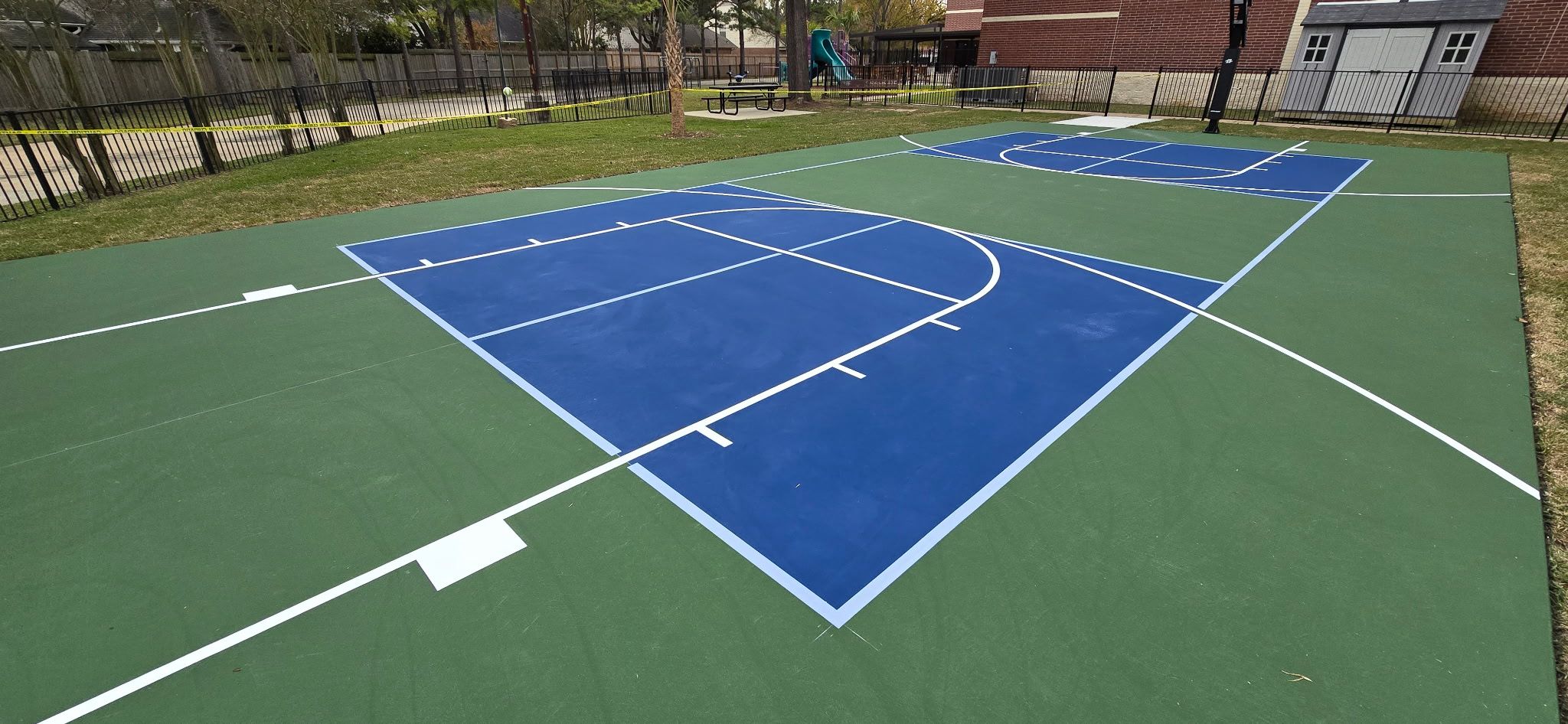
They are applied over a suitable asphalt or concrete base and can provide color, texture, traction, and clear line markings. Several coating layers may be used to create the finished surface.
Acrylic can be a practical choice for:
• Backyard courts
• School outdoor areas
• Community courts
• Apartment communities
• Parks and recreation facilities
• Training areas
Outdoor acrylic surfaces are exposed to ultraviolet light, rain, dirt, heat, and temperature changes. The quality of the base, drainage, preparation, and coating application all affect performance.
Why Does the Base Matter So Much?
Acrylic is a finish, not a structural solution.
If the pavement settles, water collects, or cracks continue moving, the coating above it can show the same problems. The court should be inspected and repaired before resurfacing.
Our basketball court construction services include site preparation, drainage planning, base work, surfacing, equipment, and line layouts.
Is Rubber Flooring Appropriate for Basketball?
Rubber flooring can be useful in some indoor training or recreation settings, but not every rubber product is suitable for basketball.
Rubber is often selected for durability, noise reduction, and impact resistance. Its texture and resilience vary widely. Some products are designed for weight rooms or fitness areas and may feel too soft, too grippy, or too slow for basketball movement.
Before choosing rubber, ask:
• Is the product intended for basketball?
• How does the ball respond on the surface?
• Does it support quick changes of direction?
• How are seams handled?
• What cleaning products are allowed?
• Will rolling equipment leave marks?
• Is the subfloor suitable?
A product that works well beneath exercise equipment is not automatically appropriate for a playing surface.
What Is the Best Flooring for an Outdoor Court?
For many outdoor projects, the most practical option is an acrylic coating system installed over a properly prepared concrete or asphalt base.
The right choice still depends on the property. A concrete base may offer a different installation path from asphalt. A cushioned outdoor system may be considered when comfort is a priority and the site can support the additional layers.
Outdoor material decisions should account for:
• Sun exposure
• Rain and drainage
• Heat
• Soil movement
• Tree roots
• Irrigation
• Expected playing volume
• Cleaning
• Future resurfacing
• Available budget
The surface should be selected with the Texas climate in mind. Strong sunlight can fade color. Heavy rain can expose drainage weaknesses. Expansive soil can move the pavement beneath the coating.
How Does the Base Affect Flooring Performance?
The base carries the surface, equipment, players, and weather exposure.
For an outdoor court, the base may involve compacted soil, aggregate, asphalt, concrete, joints, reinforcement, and drainage. For an indoor court, the subfloor may need moisture testing, leveling, resilient components, or repairs before the flooring is installed.
A new floor cannot compensate for:
• Settlement
• Broad structural cracking
• Trapped moisture
• Poor slope
• Uneven support
• Failing joints
• Unstable soil
This is why a flooring recommendation should follow a site and base evaluation.
If an existing court is faded but stable, basketball court resurfacing may restore the finish without a complete rebuild. If the pavement is moving or drainage is failing, deeper work may be needed first.
How Should Traction Be Evaluated?
Traction should help players stop and turn with control.
Too little grip can make the court feel slippery. Too much can make movement feel abrupt and uncomfortable. Dirt, moisture, algae, cleaning residue, worn texture, and incorrect products can all affect how the surface feels.
Traction should be reasonably consistent across the court. A repaired patch, painted line, or high traffic area should not feel noticeably different from the surrounding floor.
The intended use matters as well. A school court may receive heavy traffic from many types of shoes. A private court may have fewer users but more exposure to outdoor dirt, leaves, and rain.
How Does Ball Response Affect the Flooring Choice?
A basketball surface should give the ball a reasonably predictable response.
Hardwood, synthetic, acrylic, rubber, and cushioned systems each interact with the ball differently. The base, finish, texture, temperature, and moisture also play a role.
The ball should not feel unusually dead in one area or lively in another. Broad changes in response can point to uneven support, moisture, worn finish, or inconsistent installation.
If the court will host formal competition, the owner should confirm which surface and equipment standards apply. For residential or recreational projects, the material can be selected around the desired feel and budget.
What Should You Know About Lines and Color?
The line coating needs to bond with the playing surface and remain easy to see.
A court may include boundaries, the center line, the free throw lane, the free throw circle, the three point arc, and custom markings. Schools and communities may need multiple layouts for different age groups or activities.
Color choices affect visibility, heat, glare, and the overall appearance of the property. Very dark outdoor colors can become hotter in direct sunlight. Strong contrast is useful, but too many bold markings can make the court difficult to read.
Lines should be measured from verified reference points. Repainting old markings without checking their accuracy can carry an earlier error into the new surface.
Our court painting services include preparation, color application, basketball lines, and custom layouts.
How Do You Choose Flooring for Indoor Versus Outdoor Use?
The first decision is where the court will live.
Indoor Flooring Priorities
Indoor owners often focus on:
• Impact response
• Ball bounce
• Player comfort
• Moisture control
• Cleaning
• Conversion for other events
• Seating and equipment loads
Hardwood, synthetic, and cushioned systems are common options.
Outdoor Flooring Priorities
Outdoor owners usually need to consider:
• Ultraviolet exposure
• Rain
• Drainage
• Heat
• Soil movement
• Cracks
• Cleaning
• Future resurfacing
• Fence and hoop footings
Acrylic systems over suitable concrete or asphalt are common for outdoor use.
Using an indoor flooring product outdoors or an outdoor coating indoors can create compatibility and performance problems. The material should be selected for the environment where it will be installed.
What Should You Ask a Flooring Contractor?
Before approving the surface, ask for details about the complete system:
• What material is being proposed?
• Is it designed for basketball?
• What base or subfloor does it require?
• How will moisture be checked?
• What repairs are included?
• How are seams or joints handled?
• What texture and traction should players expect?
• Which cleaning products are allowed?
• How long will installation and curing take?
• What equipment can be placed on the surface?
• How will future repairs be completed?
• What warranty applies?
The contractor should be able to explain the reasoning behind the recommendation rather than presenting one material as the answer for every project.
How Is Basketball Flooring Installed?
The process depends on the material and the condition of the site.
Site Review and Testing
The court area is measured and checked for slope, flatness, moisture, cracks, access, drainage, and existing equipment.
Base Preparation
The base or subfloor is cleaned, repaired, leveled, or rebuilt as required by the selected system.
Flooring Installation
Hardwood, synthetic flooring, cushioned layers, acrylic coatings, or another approved system is installed according to its specifications.
Lines and Equipment
The basketball layout is measured and painted after the surface is ready. Hoops, padding, nets, anchors, fencing, and lights are installed or adjusted.
Final Inspection
The completed court is reviewed for surface consistency, lines, transitions, equipment, drainage, and surrounding access.
The court stays closed until the material has cured or acclimated enough for regular use.
How Much Does Basketball Court Flooring Cost?
The cost depends on the surface and the work beneath it.
Hardwood, synthetic, cushioned, acrylic, and rubber products involve different materials and installation methods. Base repairs, moisture work, drainage, equipment, colors, lines, lighting, and access can also affect the estimate.
A useful proposal should separate:
• Base or subfloor work
• Flooring materials
• Surface preparation
• Repairs
• Color coats
• Line painting
• Equipment
• Lighting
• Fencing
• Cleanup
• Future maintenance
A low material price may not represent the lowest total project cost if the base requires significant work or the product needs specialized maintenance.
How Should the Court Be Maintained After Installation?
Each surface has its own care requirements.
Hardwood needs approved cleaning, moisture control, and protection from unsuitable loads. Synthetic and cushioned floors need compatible cleaners and attention to seams, wear, and surface response.
Outdoor acrylic courts need debris removal, prompt spill cleaning, clear drainage, and periodic inspection for cracks, fading, peeling, and worn texture.
Quality & Heritage Court Services provides basketball court maintenance for cleaning, equipment checks, repairs, resurfacing, and line care.
Maintenance should also account for how the court is used. Portable goals, benches, bleachers, stages, and rolling equipment can damage a surface when moved carelessly.
What Are the Most Common Questions About Basketball Court Flooring?
Hardwood is a common choice for dedicated indoor facilities because it offers a familiar feel and consistent ball response. Synthetic and cushioned systems can also work well when the owner wants different maintenance, comfort, or design characteristics.
Acrylic coating over a properly prepared asphalt or concrete base is a common outdoor option. The right choice depends on drainage, pavement condition, sun, heat, soil movement, expected use, and maintenance.
Neither is automatically better. Hardwood offers a traditional playing experience and can be refinished. Synthetic flooring may offer different cushioning, color, maintenance, and cost advantages. The complete system and intended use should guide the decision.
They can be worth considering when player comfort and frequent use are priorities. The value depends on the quality of the system, the base, playing volume, budget, and maintenance plan. Cushioning cannot correct an unstable or damp subfloor.
Possibly. The slab should be checked for cracks, moisture, flatness, movement, slope, and structural condition. A suitable existing base may reduce the work, but serious damage needs correction before flooring is installed.
Service life varies with the material, base, installation, playing volume, cleaning, equipment, weather, and maintenance. Indoor hardwood may be refinished over time. Outdoor acrylic surfaces eventually need repair, recoating, or resurfacing.
Why Should You Choose Quality & Heritage Court Services?
Flooring Recommendations Based on Use
The surface is considered in relation to the players, playing volume, location, comfort, maintenance, and budget.
Base and Surface Planning Together
The team reviews the layers below the finish instead of treating flooring as an isolated product choice.
Indoor and Outdoor Experience
Projects can be planned for backyard courts, schools, communities, training facilities, clubs, and commercial properties.
Connected Construction Support
Quality & Heritage Court Services can coordinate the base, drainage, flooring, color, lines, hoops, lighting, fencing, and ongoing care.
Property owners can find local support through our Houston, Austin, Dallas, and San Antonio service pages.
Ready to compare basketball flooring options? Contact our team to arrange a site evaluation.