Overview
A volleyball court looks straightforward when you see it from the stands. There is a rectangle, a net across the middle, and a few lines painted on the floor.
Planning one from scratch quickly reveals how much more space the game needs.
Official volleyball court dimensions describe the area inside the boundary lines. Players also need a clear free zone beyond those lines and unobstructed space above the court. The posts sit outside the sidelines, not on them. Team areas, walkways, seating, padding, lighting, and equipment add to the complete facility footprint.
The type of volleyball matters too.
Indoor six-player volleyball uses a larger court than beach doubles. An outdoor hard-court layout may follow indoor measurements, while a recreational sand court might be designed for doubles, fours, sixes, or a mixture of formats.
A homeowner may not need a competition venue, but the court should still provide enough room to serve, chase a ball, and move safely. A school or commercial facility may need to meet specific league, accessibility, spectator, and operational requirements.
Quality & Heritage Court Services plans indoor and outdoor volleyball courts for homes, schools, communities, clubs, and recreational facilities. If you are trying to determine how much room your project needs, contact Quality & Heritage Court Services today to discuss the property and intended level of play.
What Are the Official Indoor Volleyball Court Dimensions?
A regulation indoor volleyball court measures 18 meters long by 9 meters wide.
In feet, that is approximately 59 feet by 29 feet 6 inches.
The net divides the playing court into two equal sections. Each team plays within an area measuring 9 meters by 9 meters, or approximately 29 feet 6 inches by 29 feet 6 inches.
The current FIVB Official Volleyball Rules confirm the 18-meter by 9-meter court and require a free zone around it.
These dimensions are measured from the outer edges of the boundary lines. The lines are included within the playing court.
A regulation rectangle alone is not enough for a usable court. Players regularly move beyond the sidelines and end lines to serve, defend, or chase a ball. The surrounding free zone is therefore part of the playing area even though it is not part of the marked court.
How Much Total Space Does an Indoor Volleyball Court Need?
For ordinary regulation play, the court is surrounded by a free zone at least 3 meters wide on all sides.
Adding that minimum free zone creates a playing area measuring 24 meters long by 15 meters wide. In feet, this is approximately 78 feet 9 inches by 49 feet 3 inches.
That is still not the complete building footprint.
Walls, columns, benches, scorer tables, walkways, bleachers, storage, doors, padding, and building systems need additional room. A gym that measures exactly 24 meters by 15 meters internally would leave no space outside the minimum free zone for circulation or facility use.
Official international competition uses more generous clearances. FIVB World and Official Competitions require a free zone extending 5 meters beyond the sidelines and 6.5 meters behind the end lines.
That creates an official competition playing area of 31 meters by 19 meters, or approximately 101 feet 8 inches by 62 feet 4 inches.
Most residential, school, and recreational courts do not need to reproduce an international event venue. Still, larger free zones improve safety and make the court feel less restricted.
Why Is the Free Zone So Important?
The free zone is the clear area immediately outside the court boundaries.
It is not leftover floor. It is an active part of volleyball.
Servers begin behind the end line. Defenders chase balls beyond the sideline. Players carry momentum after a dig, jump, or emergency save. A wall, column, bench, or step placed too close to the boundary can turn an ordinary play into a collision.
The minimum free zone should remain free from objects that could interfere with movement. Depending on the facility, that includes:
• Walls and structural columns: Players tracking the ball may not be looking ahead. Greater separation and appropriate padding are especially important near fixed building elements.
• Benches and equipment: Chairs, ball carts, scorer tables, storage racks, and training equipment should remain outside active run-off space.
• Doors and floor changes: An open door, raised threshold, step, drain, or flooring transition can create a tripping or impact hazard near the court.
A private court may not see the same speed as a varsity gym, but people still need room to slow down and recover safely.
How High Does an Indoor Volleyball Court Need to Be?
The free playing space above a standard court must be at least 7 meters high, which is approximately 23 feet.
For FIVB World and Official Competitions, the required unobstructed height is at least 12.5 meters, or approximately 41 feet.
The keyword is unobstructed.
Clear height is measured from the playing surface to the lowest object above the court. That object may be a roof beam, light fixture, fan, duct, basketball hoop, scoreboard, sprinkler pipe, netting system, or structural brace.
A building may have a high roof peak but still be unsuitable for regulation volleyball if a beam crosses the space at 18 feet.
Volleyball sends the ball high above the net during sets, serves, and defensive plays. Low ceilings interrupt rallies and change how players approach the game.
When planning indoor volleyball court construction, confirm the position of every overhead system before approving the court layout.
Where Is the Attack Line Located?
Each side of an indoor volleyball court has an attack line positioned 3 meters, or approximately 9 feet 10 inches, behind the axis of the center line.
This line is often called the three-meter line or 10-foot line.
It separates the front zone from the back zone and plays an important role in how back-row players attack the ball.
The attack line extends across the 9-meter width of each half. Under applicable competition layouts, broken extensions can continue beyond the sidelines to help officials judge position.
For a recreational backyard court, owners sometimes omit the attack lines to keep the layout simple. Schools, training centers, clubs, and competitive facilities generally benefit from accurate markings.
If a court will support different age groups or formats, line colors should be planned carefully. Too many overlapping markings can make the surface difficult to read.
Where Is the Center Line?
The center line runs beneath the net and divides the 18-meter-long court into two 9-meter halves.
Its entire width belongs equally to both sides under the applicable court layout.
The center line needs to align with the net, posts, and court center. If those elements are installed from different reference points, even a small error can become visible across the full width.
Sleeves or post foundations should be positioned before the final floor finish and markings. Moving the net system after striping can leave the court permanently misaligned.
For a multi-use court, the volleyball center line may cross basketball, pickleball, or other markings. Contrasting colors help players identify the correct game.
How Wide Are Volleyball Court Lines?
Indoor volleyball court lines measure 5 centimeters wide, which is just under 2 inches.
The boundary lines, center line, and attack lines should contrast with the playing surface and remain easy to see under the facility’s lighting.
The two sidelines and two end lines are included within the official 18-meter by 9-meter court dimensions.
This means measurements should be taken to the outside edge of the boundary lines rather than treating the line as extra width beyond the court.
Line accuracy affects more than appearance. Officials and players make decisions based on the boundary. Crooked, uneven, or poorly contrasted lines create uncertainty during close plays.
Professional layout should happen after the surface has been completed and verified.
What Is the Official Volleyball Net Height?
Net height varies by competition category.
For standard adult indoor volleyball, the net is set at:
• 2.43 meters for men: This is approximately 7 feet 11⅝ inches. The measurement is taken at the center of the court.
• 2.24 meters for women: This is approximately 7 feet 4⅛ inches. The height above the sidelines should not exceed the permitted tolerance.
Youth, junior, senior, sitting, and recreational programs may use different heights. A facility serving several groups should consider an adjustable net system.
The net itself is generally 1 meter wide and approximately 9.5 to 10 meters long. It extends beyond the 9-meter playing width so it can connect securely to the posts.
The equipment system should maintain consistent tension without introducing exposed cables, sharp hardware, or unstable supports.
Where Should the Volleyball Posts Be Installed?
Volleyball posts sit outside the sidelines.
Under standard FIVB rules, they are placed between 0.5 meter and 1 meter outside each sideline. For applicable FIVB competitions, they are positioned 1 meter outside.
The posts should not project into the playing court. They also need padding because players can travel beyond the boundary while following the ball.
Post placement affects the total width of the facility. A court that fits between two walls at exactly 9 meters wide has nowhere to install regulation posts and offers no free zone.
Floor sleeves are common in permanent indoor installations. When volleyball is not in use, the posts can be removed and the sleeves covered with flush caps.
The sleeves, anchors, and subfloor should be designed together. Cutting into a completed floor without understanding the foundation or embedded utilities can create expensive problems.
How Large Is an Outdoor Hard-Court Volleyball Court?
Outdoor six-player volleyball can use the same 18-meter by 9-meter playing dimensions as indoor volleyball.
The layout still needs a free zone around the court and room above for unobstructed ball movement. The primary construction differences involve weather, drainage, wind, lighting, and the outdoor surface.
A residential or community hard court may also support basketball, pickleball, or other activities. If so, the volleyball net system and markings should be coordinated with the other layouts.
An outdoor hard-court project should account for:
• Drainage and slope: The surface needs to move rainwater without creating puddles or an incline that noticeably affects play.
• Texas weather: Strong sun, heat, sudden rain, and expansive soil influence foundation design, coating selection, equipment, and maintenance.
• Wind exposure: Wind affects play and places pressure on nets, posts, fencing, shade structures, and other equipment.
A court that is technically the correct size can still perform poorly if water remains on the surface or the net posts move under tension.
What Are the Official Beach Volleyball Court Dimensions?
A regulation beach volleyball court measures 16 meters long by 8 meters wide.
In feet, that is approximately 52 feet 6 inches by 26 feet 3 inches.
The net divides the court into two equal sections measuring 8 meters by 8 meters.
The current FIVB Official Beach Volleyball Rules require a free zone at least 3 meters wide on all sides for standard play.
Adding the minimum free zone creates a sand playing area measuring at least 22 meters long by 14 meters wide. In feet, that is approximately 72 feet 2 inches by 45 feet 11 inches.
For FIVB World and Official Competitions, the free zone is larger, measuring between 5 and 6 meters from the end lines and sidelines.
A private or recreational sand court does not need a full international event footprint, but reducing the free zone too far leaves players with nowhere to move beyond the lines.
Is a Beach Volleyball Court Smaller Than an Indoor Court?
Yes.
An indoor six-player court measures 18 meters by 9 meters. A beach doubles court measures 16 meters by 8 meters.
The beach court is 2 meters shorter and 1 meter narrower.
That difference reflects the format of the game. Two players cover each side in beach volleyball, and movement through sand is more demanding than movement across a hard indoor floor.
The smaller boundary does not necessarily mean a beach court requires very little land. A proper sand facility still needs a generous free zone, excavation, drainage, edging, net foundations, and access.
The total construction area can be much larger than the 16-meter by 8-meter lines suggest.
Does Beach Volleyball Have an Attack Line?
No. Standard beach volleyball does not use an attack line or center line on the sand.
Two sidelines mark the court and two end lines. Those lines are generally flexible ribbons secured by soft anchors.
The absence of painted lines keeps the layout simple, but installation accuracy still matters. The rectangle should measure correctly and remain square.
Checking the diagonals helps confirm that the court has been laid out evenly. If the opposite corners do not match, one end may be skewed.
Court lines should contrast clearly with the sand and remain flat enough that they do not become a tripping hazard.
How Deep Should the Sand Be?
For FIVB World and Official Competitions, the sand must be at least 40 centimeters deep, which is approximately 15¾ inches.
A recreational court may be designed to different project specifications. However, the depth should still support safe movement and prevent players from reaching the material below during dives or repeated use.
The sand should be fine, clean, and free from stones, shells, glass, compacted clumps, and other objects that could cut or injure players.
Not all sand is suitable for volleyball.
Material that is too coarse can be abrasive. Very fine, dusty sand may compact, drain poorly, or become uncomfortable in dry conditions—the shape and gradation of the grains influence drainage, movement, dust, and heat.
Sand selection should happen alongside the excavation and drainage design, not after the court pit is complete.
How Much Space Does a Sand Volleyball Court Really Need?
The court lines are only one layer of the project.
A complete sand court needs space for the playing boundary, free zone, edging, drainage, net posts, access, and maintenance. Seating, shade, lighting, showers, walkways, or landscaping add more.
The excavation may extend across the full playing area rather than stopping at the boundary lines. Players move and dive throughout the free zone, so that area should offer the same safe sand surface.
A court with 16-meter by 8-meter lines and a 3-meter free zone needs at least 22 meters by 14 meters of sand area. Larger clearances create a more comfortable facility.
The property also needs room for construction equipment and delivery of a substantial volume of sand.
A narrow access gate can increase labor and affect the way material reaches the site.
How Does Sand Court Drainage Work?
Good sand drains quickly, but the water still needs somewhere to go.
Placing sand directly over poorly draining soil can create a saturated pit. After heavy rain, water may remain beneath the surface, encourage organic growth, and slow the court's recovery.
A beach volleyball court may use an excavated base, drainage stone, filter fabric, perforated pipe, or another site-specific system. The correct design depends on soil, groundwater, court elevation, surrounding runoff, and the final discharge point.
The court should not become the lowest collection basin on the property.
Texas storms can deliver more water than a casual design expects. Drainage should account for rain falling on the court and water approaching from nearby roofs, parking, slopes, and landscape.
Edging should contain the sand without trapping water. It should also be positioned and protected so players do not contact a hard or sharp boundary during play.
How Much Clear Height Does Beach Volleyball Need?
Standard beach volleyball requires at least 7 meters, or approximately 23 feet, of unobstructed height above the playing surface.
For FIVB World and Official Competitions, the clear height increases to 12.5 meters, or approximately 41 feet.
An outdoor court normally has open sky, but trees, power lines, shade structures, overhead lights, and nearby building projections can interfere with the playing space.
A covered sand court needs the same careful vertical planning as an indoor gym. Roof beams, lights, fans, and netting should not interrupt serves or high defensive shots.
A low shade canopy over part of the court may provide relief from the sun but make normal volleyball impossible.
Shade and weather protection should be placed outside the playing volume or designed with enough height for the game.
What Size Should a Backyard Volleyball Court Be?
A backyard court should reflect how the family expects to play.
If the goal is realistic six-player volleyball, use the 18-meter by 9-meter indoor dimensions with as much clear free space as the property reasonably allows.
For beach doubles, the 16-meter by 8-meter layout is the appropriate starting point.
A smaller recreational court can work for children, casual games, or practice, but it will not play like a regulation facility. Reducing the boundary changes spacing, serving distance, defensive coverage, and team movement.
Before shrinking the court, consider whether a regulation playing area with a somewhat reduced but still practical free zone is possible. Never eliminate clear space to preserve painted dimensions that leave players too close to walls, fences, pools, or landscaping.
A smaller, honestly designed practice area is safer than a regulation rectangle forced into an unsuitable yard.
Can Volleyball Be Added to a Multi-Use Court?
Yes. Volleyball works well on many multi-use residential, school, and community courts.
The court needs appropriate post sleeves, net equipment, game lines, and clear overhead space. The surface should support safe movement while also meeting the needs of the other activities.
Basketball and volleyball commonly share indoor gyms. Outdoor courts can combine volleyball with basketball, pickleball, or tennis when the dimensions and equipment are coordinated.
The challenge is line clarity.
Each activity should use a distinct color that remains visible without overwhelming the surface. The main game usually receives the strongest visual treatment, while secondary layouts use quieter colors.
Removable posts and flush sleeve covers help return the space to other uses. Storage should be available for nets, antennas, post padding, referee stands, and related equipment.
See Quality & Heritage Court Services’ multi-athletic and volleyball gallery for examples of projects designed to support more than one activity.
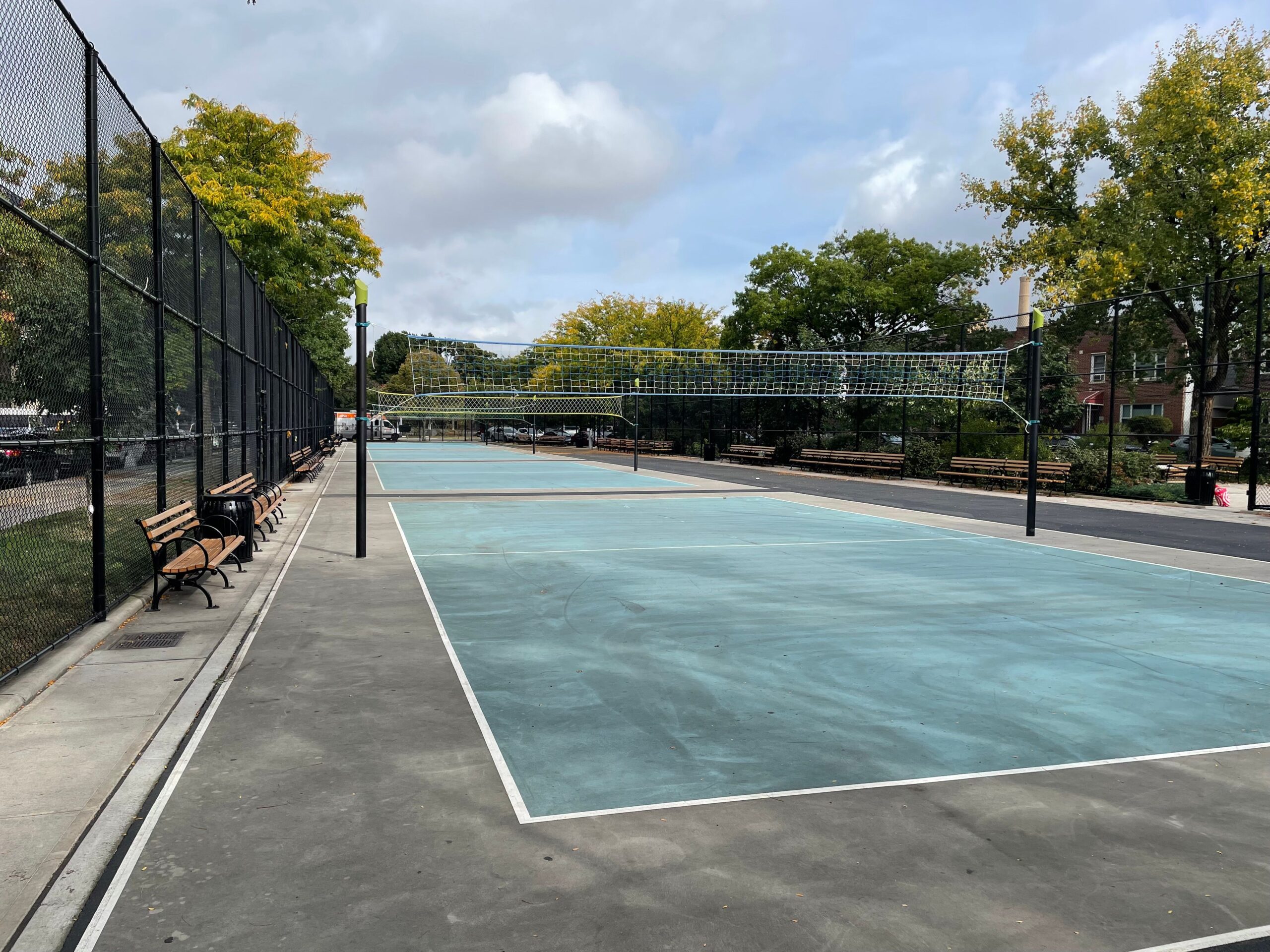
Which Surface Is Best for Volleyball?
Indoor and outdoor courts require different surfaces.
Indoor Court Flooring
Wood is common in traditional gymnasiums, while synthetic systems can offer different combinations of resilience, traction, maintenance, and multi-use performance.
The floor should support quick changes of direction without feeling slippery or excessively restrictive. It also needs enough shock response for frequent jumping and landing.
The selected system must work with the foundation, moisture conditions, building climate, and intended level of play.
Outdoor Hard-Court Surfacing
Outdoor volleyball can use a textured acrylic surface over a properly prepared concrete or asphalt base.
The coating should provide controlled traction while tolerating UV exposure, heat, and rain. Drainage and foundation stability remain essential because the finish cannot correct movement or low areas below it.
A cushioned system may be considered for multi-use applications where added comfort is a priority. Cushion X court services can help owners explore a more forgiving acrylic court surface.
Sand Court Surface
Beach volleyball requires suitable sand across the court and free zone. Grain size, cleanliness, depth, drainage, heat, and long-term maintenance all affect the finished experience.
Choosing the cheapest locally available sand can create years of discomfort and drainage problems.
Do Volleyball Courts Need Fencing or Lighting?
Fencing is optional for many volleyball courts, but it can help contain balls and separate the playing area from roads, parking, pools, or neighboring property.
The fence should remain outside the free zone. A player should not have to choose between saving the ball and colliding with the enclosure.
Lighting extends use into the evening and may be important for schools, communities, clubs, and Texas homeowners who prefer to play after the hottest part of the day.
Fixtures should provide even illumination without glare. Players look upward frequently, so poorly positioned lights are immediately noticeable.
Light poles should remain outside active run-off areas. For indoor courts, fixtures should be mounted above the required clear playing height.
Electrical work, pole foundations, controls, and local lighting restrictions should be addressed before the surface is complete.
Do You Need a Permit to Build a Volleyball Court?
You may.
Requirements depend on the property, jurisdiction, and scope of work. Grading, concrete construction, drainage, lighting, electrical service, fencing, retaining walls, shade structures, and new indoor buildings can each require approval.
A commercial or school project may also involve zoning, accessibility, parking, fire access, restrooms, occupancy, stormwater, and landscaping.
For a sand court, local authorities may review excavation, drainage, imported material, grading, or the effect on surrounding properties.
Residential owners should also check HOA and deed restrictions. Local approval does not replace private architectural requirements.
Quality & Heritage Court Services works across Austin, Dallas, Houston, San Antonio, and surrounding Texas communities.
How Much Does Volleyball Court Construction Cost?
Volleyball court construction cost depends heavily on the type of facility.
Painting volleyball lines on a suitable existing gym floor is different from constructing a new indoor building. An outdoor acrylic court requires a different scope from an excavated beach volleyball court with drainage and imported sand.
The estimate may include:
• Site evaluation and surveying
• Design, engineering, and permits
• Clearing, excavation, and grading
• Foundation or gym floor construction
• Drainage
• Indoor or outdoor surfacing
• Sand and delivery
• Net posts, sleeves, and equipment
• Court markings
• Lighting and electrical work
• Fencing
• Wall and post padding
• Shade or seating
• Storage and access
• Ongoing maintenance
The court dimensions influence the amount of material, but site conditions often create the largest differences between projects.
A flat, accessible property with suitable drainage can cost less to prepare than a sloped site behind a narrow entrance. Indoor projects add the cost of the building, structure, HVAC, lighting, fire protection, and support spaces.
Request a quote for an estimate based on the property and the type of volleyball court you want to build.
Frequently Asked Questions About Volleyball Court Dimensions
A regulation indoor volleyball court measures 18 meters long by 9 meters wide, or approximately 59 feet by 29 feet 6 inches. The net divides it into two equal 9-meter-by-9-meter halves.
With the minimum 3-meter free zone on every side, the playing area measures 24 meters by 15 meters, or approximately 78 feet 9 inches by 49 feet 3 inches. Additional room is needed for walls, benches, walkways, doors, equipment, and spectators.
A regulation beach volleyball court measures 16 meters by 8 meters, or approximately 52 feet 6 inches by 26 feet 3 inches. A minimum free zone of 3 meters on all sides creates a sand playing area of at least 22 meters by 14 meters.
The standard minimum unobstructed height is 7 meters, or approximately 23 feet. FIVB World and Official Competitions require at least 12.5 meters, or approximately 41 feet. The measurement is taken to the lowest overhead obstruction.
The attack line is 3 meters, or approximately 9 feet 10 inches, behind the axis of the center line on each side. It separates the front zone from the back zone.
No. Indoor six-player volleyball uses an 18-meter by 9-meter court. Beach doubles uses a 16-meter by 8-meter court. The surface, line layout, free-zone needs, net system, and construction are also different.
Why Choose Quality & Heritage Court Services?
A volleyball court should be measured around the way people move, not only the lines they stand inside.
Quality & Heritage Court Services considers the playing area, free zones, net system, clear height, surface, drainage, lighting, and surrounding property as one project.
• Indoor and Outdoor Planning: The team can help evaluate indoor gyms, outdoor hard courts, sand courts, and multi-use recreational spaces.
• Texas Site Experience: Heat, strong sunlight, heavy rain, soil movement, and drainage influence outdoor court construction. Those conditions are considered before the surface and equipment are installed.
• Complete Court Layout: Boundary lines, attack lines, center lines, posts, sleeves, net height, lighting, and safety clearances are planned to work together.
• Residential and Commercial Projects: A backyard court has different needs from a school, HOA, club, resort, university, or municipal facility. The court and surrounding features are planned around the expected use.
Planning an indoor, outdoor, or sand volleyball court? Contact our team to discuss dimensions, surfaces, and construction requirements.