Overview
A padel court is smaller than a tennis court and is surrounded by glass and metal walls that remain part of the game. A tennis court is larger, has an open playing area, and relies on boundaries rather than rebound walls.
The two facilities also differ in their foundations, surfaces, equipment, lighting, maintenance, and space requirements. Padel commonly uses artificial turf inside a structural enclosure, while outdoor tennis courts often use acrylic coatings over concrete or asphalt.
These differences affect construction cost, site planning, player capacity, and long-term care. The right choice depends on the property, intended players, available space, budget, and preferred playing experience.
Quality & Heritage Court Services designs, builds, resurfaces, and maintains padel and tennis courts throughout Texas.
Planning a new court? Contact Quality & Heritage Court Services to compare the requirements for your property.
How Do Padel and Tennis Court Dimensions Compare?
A regulation padel court measures 10 meters wide by 20 meters long. That is approximately 32 feet 10 inches by 65 feet 7 inches within the enclosure.
A regulation tennis court measures 78 feet long. It is 36 feet wide for doubles and 27 feet wide for singles. The complete facility needs additional space beyond the painted lines so players can move safely.
The full tennis footprint is usually much larger than the padel playing area. A tennis facility may require approximately 60 feet by 120 feet, depending on the level of play and available runoff space.
Why Does the Complete Footprint Matter?
Playing dimensions do not represent the entire construction area.
A padel facility needs room for enclosure framing, structural foundations, doors, lighting, maintenance access, pathways, and circulation between courts.
A tennis facility needs runoff space beyond the baselines and sidelines, along with fencing, gates, net-post foundations, lighting, seating, and drainage.
The International Padel Federation rules define the regulation padel playing area and enclosure. The International Tennis Federation facilities guidance provides information about tennis surfaces and recognised court systems.
Why Does a Padel Court Need Walls?
Glass and metal walls are fundamental parts of padel.
The ball can rebound from the walls and remain in play, creating angles and rallies that do not exist in tennis. The enclosure must therefore provide predictable rebounds while remaining structurally secure.
A regulation padel court typically includes tempered-glass panels, steel framing, metal mesh, doors, anchors, and connections. Each component must align accurately with the foundation.
How Is a Tennis Court Different?
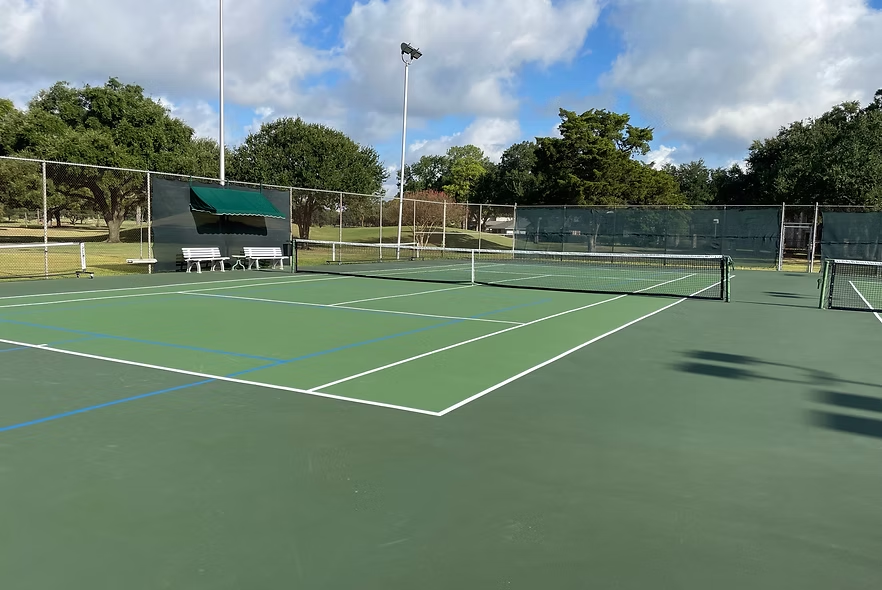
A tennis court normally has an open playing area surrounded by perimeter fencing.
The fence contains balls but is not part of active play. If the ball touches the fence or another surrounding obstruction, the point ends.
This difference changes how the facilities are designed. A tennis fence can sit beyond the runoff area, while a padel enclosure defines the playing space itself.
Which Court Requires More Land?
A single padel court generally requires less land than a full tennis court.
The smaller footprint can make padel attractive for clubs, resorts, residential communities, and commercial facilities that want several courts within a limited area.
A property that holds one tennis court may have space for more than one padel court, but the final number depends on access, circulation, drainage, parking, utilities, and supporting facilities.
Why Shouldn’t Courts Be Placed Too Close Together?
A tightly packed plan may fit on paper while creating operational problems.
Players need comfortable routes to each entrance. Maintenance crews need access to the glass, turf, lights, drainage, and structural connections. Commercial facilities also need room for spectators, waiting players, equipment, and emergency movement.
A smaller number of well-spaced courts may function better than the maximum number that can physically fit.
How Do Padel and Tennis Court Foundations Differ?
Both courts need a stable, accurately constructed foundation. The load and installation requirements are not identical.
A tennis foundation supports the pavement, surface coatings, net posts, fencing, and lighting. A padel foundation must also support the glass and metal enclosure, doors, mesh sections, and structural anchors.
The padel slab or perimeter foundation needs to match the selected enclosure system. Small errors in dimension, elevation, or anchor placement can create alignment problems during installation.
What Should Be Considered Before Concrete Is Placed?
The construction plan should confirm:
• Soil preparation: Existing soil may need excavation, moisture conditioning, compaction, or replacement before the base is installed.
• Drainage slope: The finished surface must move water away without creating low areas beneath the turf or acrylic coating.
• Reinforcement: The structural design should reflect the soil conditions, court system, and expected loads.
• Anchor locations: Padel enclosure foundations and tennis net posts need accurate positions before the final surface is installed.
• Utility routes: Electrical conduit and drainage features should be coordinated before concrete work limits access.
Texas soil conditions can vary considerably. Foundation recommendations should reflect the property rather than applying one standard detail to every site.
How Do Padel and Tennis Court Surfaces Compare?
Padel commonly uses artificial turf with infill. Tennis can use acrylic hard court systems, clay, grass, artificial turf, cushioned acrylic, and other approved surfaces.
The padel turf affects traction, ball response, movement, and comfort. Fiber type, pile height, backing, seams, and infill need to suit the selected system.
An acrylic tennis court uses layered coatings over a suitable concrete or asphalt base. Texture within the coating influences traction and playing speed.
Does the Surface Change How Each Game Feels?
Yes. Padel players make short movements within a compact enclosure and regularly change direction near the glass. The turf and infill should support controlled movement without becoming excessively slippery.
Tennis players cover a larger area and make longer lateral and forward movements. The surface affects pace, bounce, sliding, traction, and physical demand.
Neither surface should be selected only by color. Installation quality and maintenance requirements matter just as much as appearance.
How Does the Equipment Differ?
Padel and tennis use different rackets, balls, nets, and supporting equipment.
A padel racket is solid and perforated rather than strung. It is shorter and more compact than a tennis racket. Padel balls resemble tennis balls but are manufactured to different pressure and performance requirements.
The padel net is lower than a tennis net at the posts. Enclosure doors, glass, and mesh also become essential game equipment.
Which Equipment Is Built Into the Court?
A padel court commonly includes:
• Glass panels and metal framing
• Mesh wall sections
• Doors and entry hardware
• Structural anchors
• Artificial turf and infill
• Padel net and posts
• Integrated or enclosure-mounted lights
A tennis court generally includes a net, posts, center strap, perimeter fence, gates, and lighting. Backboards, windscreens, benches, scoreboards, and ball-control dividers may be added based on the facility.
How Does the Playing Experience Compare?
Padel is commonly played as doubles on a compact court. The enclosure keeps the ball in play and creates longer rallies, rebounds, and angles.
Serving is underhand, which can make the game easier for new players to begin. The smaller court reduces the amount of open ground each player must cover.
Tennis can be played as singles or doubles. It uses overhand serving, a larger playing area, and a broader range of power, spin, movement, and positioning.
Is Padel Easier to Learn Than Tennis?
Many beginners find padel easier to start because of the underhand serve, shorter racket, smaller court, and doubles format.
That does not mean advanced padel is simple. Players need to understand wall rebounds, positioning, patience, angles, and teamwork.
Tennis may take longer for a beginner to serve and rally consistently, but both games offer progression from recreational to competitive play.
How Do Lighting Requirements Differ?
Both courts need even illumination with controlled glare and limited shadows.
Padel lights are often attached to or coordinated with the enclosure. Their height and position must remain outside the playing space and should not interfere with high lobs.
Tennis lighting covers a larger footprint. Fixtures and poles must illuminate the baselines, sidelines, net area, and player movement zones consistently.
Can One Lighting Plan Work for Both Courts?
Not without review.
The court dimensions, player positions, fixture heights, pole locations, and surrounding structures differ. A lighting plan created for one tennis court may not provide balanced coverage when the area is converted into several padel courts.
Electrical capacity, local ordinances, neighboring properties, and operating hours should also be considered before final fixture selection.
Which Court Is More Affected by Weather?
Outdoor padel and tennis courts both depend on weather, but their materials respond differently.
Padel glass and metal absorb heat. Turf, infill, frames, seals, fasteners, and electrical components remain exposed to sunlight and rain.
Tennis acrylic coatings can fade, wear, crack, or become stained. Clay courts have a separate maintenance routine involving moisture, brushing, rolling, and surface material.
How Does Rain Affect Each Court?
Rain can make both courts unavailable until the playing surface is safe.
A padel foundation needs the correct slope so water can leave through or beneath the turf system. Edges and drainage paths should remain clear of leaves and soil.
An acrylic tennis court also depends on accurate surface slope. Low areas can hold water long after the surrounding surface dries.
Outdoor design should consider where runoff travels after it leaves the playing area. Water should not collect beside the foundation or move toward buildings and neighboring properties.
How Do Maintenance Requirements Compare?
Padel maintenance focuses on turf, infill, glass, frame connections, doors, mesh, nets, lights, anchors, and drainage.
Tennis maintenance depends heavily on the selected surface. Acrylic courts need cleaning, crack monitoring, drainage care, repainting, and periodic resurfacing. Clay courts require more frequent brushing, watering, line cleaning, rolling, and patching.
What Does Routine Padel Maintenance Include?
Padel maintenance may include:
• Brushing turf fibers and redistributing infill
• Removing leaves and debris
• Cleaning glass panels
• Checking doors and latches
• Inspecting frame connections and anchors
• Examining mesh and protective coatings
• Checking lights and electrical components
• Keeping drainage paths open
Busy commercial courts may need more frequent turf and glass care than private residential courts.
What Does Routine Tennis Maintenance Include?
An acrylic tennis court should be swept or blown clean, inspected for cracks and puddles, and cleaned with surface-compatible methods.
Net hardware, fencing, gates, lights, windscreens, and surrounding landscaping also require attention.
The acrylic system commonly needs resurfacing every four to eight years, although use, weather, drainage, and pavement condition determine the actual schedule.
Which Court Costs More to Build?
Cost depends on the site, foundation, selected court system, access, drainage, lighting, fencing, utilities, and surrounding facility.
A padel court has a smaller playing area but requires a specialised glass and metal enclosure. Imported or custom components can also affect lead times and cost.
A tennis court uses a larger foundation and playing surface. The budget may increase when the property requires extensive grading, retaining walls, drainage, lighting, fencing, or premium surface systems.
Why Is the Lowest Court Quote Not Always the Lowest Project Cost?
A court quotation may cover only the main playing components.
The completed budget may also need to include:
• Site clearing and grading
• Soil correction and base preparation
• Drainage
• Concrete or asphalt
• Electrical service
• Lighting
• Walkways and accessible routes
• Parking
• Seating and shade
• Landscaping restoration
• Permits and engineering
Compare proposals by complete scope rather than looking only at the price of the enclosure or surface.
Can a Tennis Court Be Converted Into Padel Courts?
A tennis area may have enough space for one or more padel courts, but conversion requires more than changing the lines.
The existing pavement, dimensions, drainage, slope, access, utilities, and foundation need to be evaluated. The padel enclosure requires structural anchors and foundations that may not exist within the tennis slab.
Existing tennis fencing and lighting may also need to change.
Can the Existing Tennis Surface Be Reused?
Possibly, but it should not be assumed.
The pavement must have suitable dimensions, stability, slope, and elevation. Cracks, low areas, joints, coatings, and drainage should be reviewed before the enclosure system is selected.
Additional concrete work may be required for anchors, perimeter foundations, access, or drainage.
Which Court Works Better for a Private Property?
A private owner should consider space, playing preferences, number of users, maintenance, noise, and budget.
Padel can work well when the family prefers doubles play and wants a compact, enclosed game. Tennis may be the better choice for owners who play singles, want traditional training, or prefer a more open facility.
The court should be positioned with enough separation from the home and neighboring properties. Lighting, drainage, landscaping, and operating hours should also be considered.
Which Court Works Better for a Commercial Facility?
Padel can provide more courts within a given land area, which may increase the number of simultaneous bookings.
Tennis remains important for coaching, leagues, tournaments, junior development, and established club programs.
The better commercial plan may include one type of court or a combination of both. The decision should reflect local demand, membership, programming, staffing, parking, support facilities, and expected operating hours.
Which Questions Should a Commercial Owner Ask?
Before choosing, consider:
• How many players can the property serve at once?
• Which activity has stronger local demand?
• How will lessons and leagues be scheduled?
• Is the facility indoor or outdoor?
• How much parking is available?
• What maintenance will each surface require?
• Can the property support future expansion?
• How will players move between courts?
A feasibility review should consider the complete operation rather than only the court footprint.
What Are the Most Common Questions About Padel and Tennis Courts?
Yes. A regulation padel court measures 10 by 20 meters, while a tennis court uses a 78-foot playing length and requires considerably more runoff space. The complete facility footprint must also include fencing or enclosure, access, lighting, and maintenance areas.
No. The padel court is smaller and enclosed by playable walls, so it cannot support regulation tennis. The net, surface, dimensions, equipment, and playing rules are also different. Padel requires its own dedicated layout and enclosure.
Many beginners find padel easier to start because it uses an underhand serve, a shorter racket, doubles play, and a smaller court. Advanced play still requires strong positioning, wall awareness, teamwork, and control. Both games offer recreational and competitive development.
It can, despite its smaller footprint, because it requires tempered glass, structural framing, mesh, turf, doors, and specialised installation. A tennis court requires a larger foundation and surface. Final cost depends on the site and complete project scope.
It may be possible when the paved area, surrounding space, access, drainage, and utilities support the new layout. The existing slab still needs structural evaluation because padel enclosure anchors may require additional foundations. Lighting and fencing may also need to change.
The answer depends on the surface and amount of use. Padel requires turf, infill, glass, frame, door, and enclosure maintenance. An acrylic tennis court needs cleaning, crack monitoring, repainting, drainage care, and periodic resurfacing.
Why Should You Choose Quality & Heritage Court Services?
Quality & Heritage Court Services designs and installs padel and tennis courts around the actual property and intended use.
The Site Is Evaluated Before the Court Is Chosen
Available space, soil, slope, drainage, utilities, construction access, surrounding structures, and future maintenance are reviewed before the layout is finalised.
Each Court Is Designed as a Complete System
Foundation, surface, enclosure or fencing, lighting, equipment, gates, drainage, and player circulation are planned together.
Residential and Commercial Projects Receive Different Plans
A private estate requires a different approach from a club, school, residential community, resort, or commercial facility.
Texas Conditions Shape the Recommendations
Heat, sunlight, heavy rain, wind, expansive soil, and long dry periods influence construction and material decisions.
Contact Quality & Heritage Court Services today to compare padel and tennis options for your property.