Overview
A professionally built pickleball court in Texas commonly starts around $25,000 and can reach $60,000 or more for a complete outdoor installation. Challenging land, post-tension concrete, cushioned surfacing, extensive fencing, lighting, retaining work, and limited construction access can move the final price higher.
That range is useful for early planning, but it is not a quote.
Two properties can have the same open space and produce different budgets. One may be level and accessible. The other may need excavation, drainage, soil correction, retaining walls, longer electrical runs, or special equipment.
Quality & Heritage Court Services designs and builds custom pickleball courts for homes, private estates, schools, residential communities, clubs, municipalities, and commercial properties across Texas.
Planning a pickleball court? Contact our team for a site evaluation and a detailed estimate based on the property and complete construction scope.
What Is Included in the Cost of a Pickleball Court?
A complete court price covers much more than acrylic color and white lines.
The project begins with the land. The site has to be measured, cleared, graded, and prepared to support a stable foundation. Water needs a reliable route away from the playing area. The base must then be constructed to the correct dimensions, slope, and tolerances before any surface coating can begin.
Once the foundation is ready, the project moves into surfacing, striping, net installation, fencing, lighting, and finishing work. A clear estimate should identify what is included and what remains optional.
Site Evaluation and Layout
The first step is deciding whether the preferred location can support the court.
The builder reviews the usable footprint, slope, soil, drainage, access, sunlight, buildings, trees, utilities, easements, and property boundaries. The court may also need to fit around a pool, patio, septic area, landscaping, or HOA restrictions.
Ground Preparation and Foundation
Grass, topsoil, roots, unsuitable fill, and soft areas may need to be removed. The remaining ground is shaped and compacted before the aggregate base and concrete system are installed.
Foundation work is usually one of the largest parts of the budget. It also has the greatest influence on long-term performance. A beautiful surface cannot make up for movement, low areas, or poor drainage below it.
Surfacing, Lines, and Equipment
After the concrete has cured and the surface has been prepared, the acrylic system is installed in several layers. The selected colors and regulation lines are then applied with the proper texture for traction and ball response.
The net system, posts, center strap, anchors, and sleeves also need to be included. Permanent equipment usually costs more than a portable setup, but it creates a cleaner and more dependable dedicated court.
How Much Space Are You Actually Paying to Build?
The official playing lines measure 20 feet wide by 44 feet long for both singles and doubles. The official pickleball court dimensions guide explains the line layout and surrounding clearance in more detail.
The finished surface needs room outside those lines so players can move safely. The USA Pickleball Official Rulebook lists a minimum playing surface of 30 feet by 60 feet and recommends 34 feet by 64 feet for new construction.
That difference matters when estimating cost.
A price calculated only from the 20 by 44 foot rectangle leaves out a large part of the actual foundation and finished surface. Contractors may also be pricing different total footprints, even when both proposals describe one regulation court.
Why Does the Runoff Area Matter?
Players need space beyond the baselines and sidelines to chase the ball, slow down, and move around the net posts without meeting a fence, wall, light pole, or landscaped edge.
Before comparing prices, confirm the complete slab dimensions in each proposal.
Why Does Site Preparation Change the Price So Much?
A flat lawn does not always mean an easy construction site.
The ground may contain expansive clay, old fill, buried roots, soft areas, or drainage paths that become visible only after rain. The court location may also sit below the home, beside a retaining wall, or at the bottom of a neighboring slope.
The amount of preparation depends on what the land needs before it can support the foundation.
Property owners can review the backyard pickleball court planning guide for additional guidance on space, soil, access, and drainage.
Slope and Elevation
A gentle grade may need ordinary excavation and leveling. A steeper property can require deeper cuts, imported fill, retaining structures, erosion control, or additional concrete around the perimeter.
The objective is not simply to make the top look level. The entire prepared platform needs to remain stable while allowing the finished surface to drain correctly.
Construction Access
The work area must be reachable by excavation equipment, concrete crews, fencing, and electrical contractors.
Wide street access can keep the work straightforward. A court behind a home may require smaller machines, concrete pumping, temporary fence removal, or landscaping restoration.
Texas Soil Conditions
Many Texas properties contain clay-rich soil that expands when it absorbs moisture and shrinks during dry periods. That movement can place stress on concrete.
The appropriate response depends on the site. Soil preparation, drainage, reinforcement, and foundation design should be selected for the actual conditions rather than copied from another property.
Quality & Heritage Court Services evaluates these practical conditions as part of its pickleball court construction planning.
How Does the Foundation Affect the Budget?
Concrete is not one interchangeable line item.
The budget can change based on slab size, thickness, reinforcement, edge design, subgrade preparation, aggregate base, vapor protection, concrete access, pumping, engineering, and the selected construction method.
Reinforced and Post-Tension Concrete
Reinforced concrete uses steel reinforcement to help manage loads and cracking. Post-tension concrete uses tensioned cables within the slab to place the concrete under compression.
Post-tension construction can cost more initially, but it may be recommended where soil movement, crack control, or long-term performance justify the added system. The correct choice should come from site conditions and engineering, not from choosing the cheapest foundation description.
Curing Time Has a Cost Too
Concrete requires time before acrylic coatings can be installed. Rushing the surface work can trap moisture or interfere with coating performance.
A realistic project plan accounts for curing, weather, surface preparation, and the coating schedule. A shorter promised timeline is not valuable if the finished surface fails early.
How Much Does Drainage Add to the Project?
Drainage may be a modest part of a simple site or a major part of a difficult one.
The finished court needs a controlled slope so rain can leave the surface. Water approaching from roofs, patios, lawns, neighboring land, or higher elevations also needs to be redirected before it reaches the foundation.
Some properties can rely on careful grading and a clear discharge route. Others need channels, collection boxes, underground piping, perimeter drains, swales, or retaining work.
Why Is Drainage Worth Budgeting for Early?
Standing water delays play and leaves dirt concentrated in low areas. Repeated moisture can also contribute to coating problems, erosion, foundation movement, and recurring repairs.
Drainage is easier to build before the slab, fence, landscaping, and surrounding walkways are complete. Adding it later may mean disturbing finished work and spending more to correct a problem that could have been planned from the beginning.
Texas rain can arrive quickly and heavily. The plan should consider where the water goes after it leaves the playing surface, not only how it crosses the court.
How Do Surface Choices Change the Cost?
The surface affects traction, ball response, comfort, appearance, maintenance, and budget.
A standard acrylic system is usually the most direct option for a permanent outdoor court. It provides the familiar firm response associated with hard-court play and allows owners to select colors and line layouts.
A cushioned system adds resilient layers beneath the acrylic finish. Those layers can make the court feel more forgiving underfoot while preserving a consistent playing surface.
Standard Acrylic Surface
Standard acrylic is practical for homes, schools, communities, and commercial facilities. The total depends on surface preparation, the number of coating layers, color choices, texture, and line work.
The pickleball court repainting guide explains how weather, use, and surface condition affect future coating work.
Custom logos and additional game lines can be added when they fit the design, but they increase layout and installation time.
Cushioned Surface
A premium cushioned surface costs more because it requires additional materials and installation steps. Owners often choose it when comfort, frequent play, mixed age groups, or a high-end finish matters.
Cushion X courts can be planned for pickleball projects where the base and intended use support the system.
The best surface is not automatically the most expensive one. It is the one that fits the players, expected use, maintenance plan, and long-term priorities.
How Much Do Fencing and Gates Add?
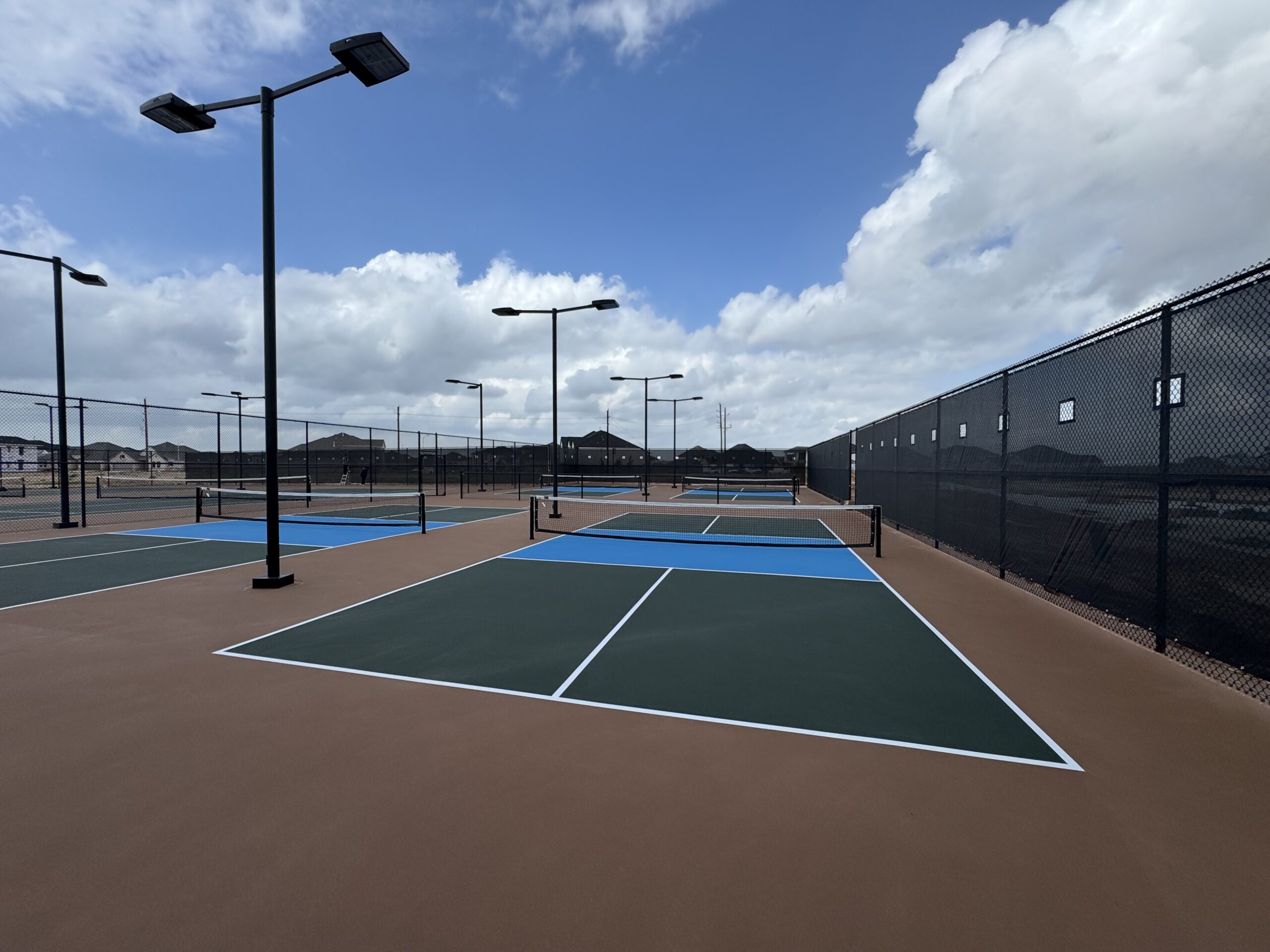
Fencing keeps balls within the playing area and separates the court from landscaping, pools, parking, roads, and nearby properties.
The price depends on total linear footage, height, material, finish, number of gates, post foundations, site access, and whether the fence includes windscreens or custom details.
A court with tight surroundings may need more complete containment. An open private property may use a different configuration. Commercial facilities need gates and circulation planned for players, staff, maintenance, and accessibility.
How Much Does Pickleball Court Lighting Cost?
Lighting can create one of the largest optional increases in the project budget.
The total includes more than fixtures. Poles, foundations, trenching, wiring, controls, electrical panels, utility capacity, permits, and access all affect the price.
The distance from the available electrical service matters. So does the number and height of poles required to provide even coverage without excessive glare.
Why Should Lighting Be Designed Before Construction?
Pole foundations and underground conduit are easier to coordinate before the court and surrounding areas are finished.
The light layout should also account for neighboring homes, streets, trees, glass, fencing, and planned hours of use. Local rules or an HOA may control pole height, brightness, operating hours, or light spill beyond the property.
Adding conduit during the first construction phase can preserve the option of installing fixtures later without reopening completed areas.
Do Permits and Approvals Affect the Final Price?
They can.
Requirements vary by address and project scope. A residential court may involve approval for concrete, drainage, fencing, lighting, electrical work, retaining walls, tree removal, setbacks, or impervious cover.
HOA or architectural approval may be separate from city or county permitting. Commercial projects can add accessibility, parking, stormwater, emergency access, landscaping, and operating requirements.
Permit fees may be a relatively small part of the total, but drawings, surveys, engineering, review time, and required design changes can affect the budget.
What Should Be Confirmed Before Work Begins?
The owner should know who will research the requirements, prepare documents, submit applications, respond to comments, and schedule inspections.
Those responsibilities should appear in the proposal. A low quote can become misleading when approvals, engineering, and administrative work are excluded without explanation.
How Can You Compare Pickleball Court Quotes Fairly?
Start by confirming that each company is pricing the same footprint and scope.
One proposal may include only the slab, acrylic surface, lines, and net. Another may include excavation, soil preparation, drainage, fencing, lighting, engineering, permits, restoration, and maintenance guidance.
The totals cannot be compared fairly until those differences are visible.
What Should a Complete Proposal Show?
• Site work: Clearing, excavation, grading, soil preparation, aggregate base, haul-off, and access requirements.
• Foundation: Dimensions, thickness, reinforcement or post-tension system, edge details, curing, and engineering.
• Drainage: Court slope, perimeter work, collection systems, piping, and discharge location.
• Surface: Preparation, acrylic or cushioned system, colors, texture, game lines, and logos.
• Equipment: Net posts, sleeves, net, center strap, anchors, and any basketball or multi-use accessories.
• Finishing work: Fencing, gates, lighting, electrical service, walkways, landscaping repair, cleanup, and inspections.
• Support: Warranty terms, maintenance recommendations, exclusions, and responsibility for future service.
Ask for exclusions in writing. A proposal should make it easy to see what the owner still needs to arrange separately.
Where Can You Adjust the Budget Without Hurting the Court?
The foundation and drainage are poor places to cut corners. Problems below the surface are difficult and expensive to correct later.
Owners who need to phase the project can often make better choices around optional features.
Lighting may be installed later if conduit and pole locations are planned now. Decorative fencing, shade structures, custom logos, seating, and extensive landscaping may also be phased without compromising the playing base.
What Are the Most Common Questions About Pickleball Court Cost?
A complete professional outdoor court commonly starts around $25,000 and can reach $60,000 or more. Difficult access, extensive grading, premium foundations, cushioned surfacing, lighting, fencing, and drainage can raise the total.
Asphalt may have a lower initial cost in some markets, while concrete can provide a different long-term foundation. Soil, climate, drainage, engineering, maintenance, and the selected surface system should guide the decision.
Usually, but not always. A simple residential site may need fewer supporting amenities. A difficult backyard with limited access, a steep slope, retaining work, or premium finishes can cost more than a straightforward commercial installation.
It may, if the slab has suitable dimensions, slope, drainage, strength, condition, and clearances. Cracks, joints, moisture, low areas, or an unsuitable finish may require correction before surfacing.
That depends on the contractor and proposal. Confirm whether fixtures, poles, foundations, conduit, wiring, controls, electrical service, permits, and utility connections are included.
Begin with a site evaluation and a clear list of desired features. The final estimate should identify the footprint, site work, foundation, drainage, surface, fencing, lighting, equipment, permits, exclusions, and warranty.
Why Should You Choose Quality & Heritage Court Services?
Quality & Heritage Court Services plans the court around the property rather than forcing every site into the same package.
Site Planning Before Pricing
Space, slope, soil, drainage, access, utilities, nearby structures, and intended use are reviewed before the complete scope is finalized.
Residential and Commercial Experience
A private backyard court has different priorities from a school, residential community, club, municipality, or commercial facility. The design and supporting work are planned for the actual users.
Complete Project Coordination
Site preparation, foundation work, drainage, surfacing, fencing, lighting, equipment, and related improvements can be coordinated as connected parts of one project.
Experience With Texas Conditions
Heat, strong sunlight, sudden rain, expansive soil, and long dry periods affect outdoor construction across Texas. Those conditions influence recommendations for the base, drainage, materials, coatings, and maintenance.
Ready for a realistic pickleball court estimate? Contact our team to discuss the property, preferred features, and complete project scope.