Overview
A well-built outdoor tennis court can last 20 years or longer, but its surface will need maintenance and periodic resurfacing throughout that time. Acrylic coatings commonly need resurfacing every four to eight years, depending on court use, construction quality, drainage, weather exposure, and maintenance.
The foundation, pavement, surface system, fencing, lighting, and equipment do not age at the same rate. A faded coating may need renewal while the underlying slab remains stable. A court with foundation movement or drainage failure may require significant work much earlier.
Texas heat, strong sunlight, heavy rain, expansive soil, and long dry periods can all affect court performance. The most reliable way to estimate the remaining life of a court is to inspect each part of the facility rather than relying only on its age.
Quality & Heritage Court Services builds, maintains, repairs, and resurfaces tennis courts throughout Texas.
Have an aging tennis court? Contact Quality & Heritage Court Services to schedule an on-site evaluation.
What Is the Average Lifespan of a Tennis Court?
The structural life of a tennis court can extend beyond 20 years when the foundation is properly designed, the site drains correctly, and the court receives regular maintenance.
The finished acrylic surface has a shorter service life. Outdoor acrylic courts often need resurfacing every four to eight years. Heavily used courts or surfaces exposed to severe weather may need attention sooner.
Individual court components also follow different timelines:
• Acrylic coatings: Commonly require repainting or resurfacing every four to eight years.
• Playing lines: May fade or wear before the surrounding surface, particularly on busy courts.
• Nets and center straps: Need replacement when they become stretched, torn, faded, or difficult to tension.
• Fencing and gates: Can last many years but require repairs when posts lean, mesh loosens, or hardware corrodes.
• Lighting: Fixtures may be upgraded before poles or electrical infrastructure need replacement.
• Foundation and pavement: Can last for decades when properly constructed and protected from severe movement or drainage failure.
These timeframes are general. Actual performance depends on how the court was built and the conditions it experiences.
Which Factors Affect Tennis Court Lifespan?
A court’s lifespan begins with site preparation and foundation design. Surface coatings cannot compensate for unstable soil, poor compaction, an unsuitable base, or incorrect drainage.
The amount of use also matters. A private residential court may receive a few hours of play each week, while a school, club, or community facility may host lessons, practices, leagues, and open play throughout the day.
Weather, shade, surrounding trees, cleaning practices, equipment movement, and repair history also influence how the court ages.
How Does Construction Quality Affect Longevity?
The foundation needs to remain stable and maintain the correct slope. Soil preparation, base compaction, reinforcement, concrete or asphalt placement, curing, and surface preparation all influence long-term performance.
A low area built into the foundation will continue collecting water after the surface is coated. A poorly prepared base may settle unevenly and create cracks or changes in elevation.
The surface system also needs a suitable substrate. Acrylic coatings require proper preparation and curing to bond successfully.
The USTA Tennis Courts manual provides technical guidance on court planning, construction, dimensions, drainage, surfaces, fencing, and lighting.
How Does Court Use Affect the Surface?
Frequent play gradually wears the texture and color coatings. Baselines and service areas often show changes before less active parts of the court.
Tennis programs, lessons, tournaments, and daily public use place heavier demands on a surface than occasional residential play. Maintenance equipment, chairs, ball baskets, and portable items can also damage the finish when dragged across the court.
High-use facilities should inspect the surface more frequently rather than waiting for visible deterioration across the entire playing area.
How Does Texas Weather Affect a Tennis Court?
Texas courts experience intense ultraviolet exposure, high surface temperatures, heavy storms, windblown dust, and major changes in soil moisture.
Strong sunlight gradually fades colors and affects acrylic coatings. Dark surfaces can become especially hot during summer afternoons. Repeated heating and cooling contribute to normal material expansion and contraction.
Heavy rain tests the surface slope and surrounding drainage. Water that remains on the court collects dirt and may reveal settlement or low areas.
Why Does Expansive Soil Matter?
Clay-rich soil changes volume as its moisture content rises and falls. It can expand during wet periods and contract during dry conditions.
Movement below the court may contribute to cracks, settlement, raised areas, or changes in surface slope. Proper site preparation and foundation design can reduce the risk, but surrounding drainage and irrigation still require attention after construction.
Water should not remain beside the foundation, and landscaping should not create uneven moisture conditions around the court.
How Does Drainage Influence Court Longevity?
Drainage affects both the playing surface and the foundation below it.
The court should have a controlled slope that moves water away from the playing area. Surrounding grades, drains, channels, curbs, landscaping, and fence bottoms must allow runoff to continue toward a suitable discharge point.
A surface that stays wet longer than expected may have a blocked drainage path or developing low area. Water approaching from outside the court may also carry soil, mulch, leaves, and other debris onto the surface.
Which Drainage Problems Should Be Addressed Early?
Watch for the following changes:
• Puddles that remain after the rest of the court dries
• Water collecting around net-post foundations
• Soil washing onto the playing surface
• Erosion beside the slab
• Blocked drains or channels
• Water entering from nearby landscaping
• New cracks appearing after extended rain
• Low areas becoming deeper or larger
Drainage problems rarely correct themselves. Addressing the cause early may protect both the surface and the surrounding construction.
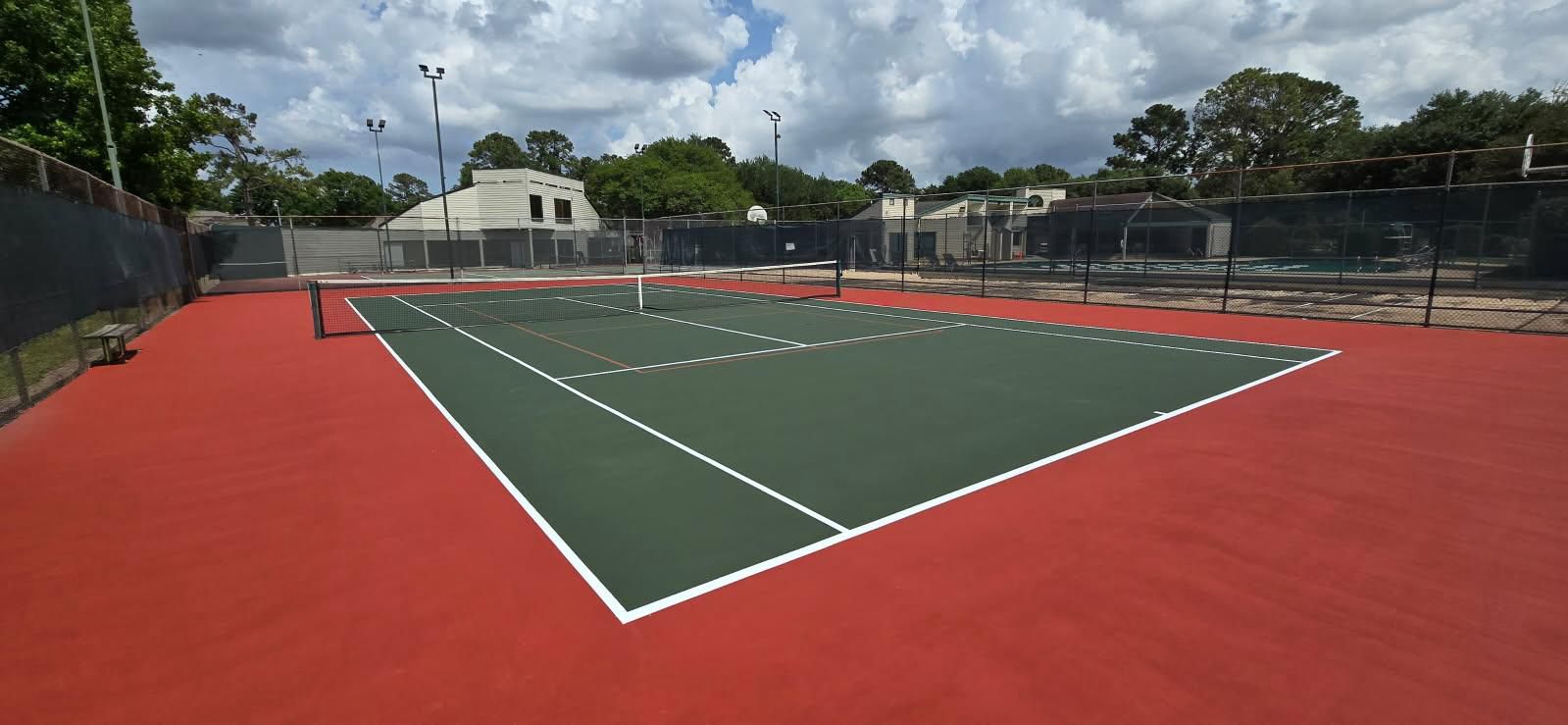
How Long Does an Acrylic Tennis Court Surface Last?
An acrylic tennis court surface commonly lasts four to eight years before resurfacing is needed. Some courts perform longer, while others require earlier attention.
Surface life depends on coating quality, preparation, use, sunlight, rain, drainage, cleaning, and the condition of the pavement below.
Acrylic layers gradually lose color and texture. Fine cracks may appear, and earlier repairs may become more visible.
The surface should be evaluated based on playability as well as appearance. A court can still look acceptable while developing smooth areas that affect traction.
Which Signs Show That the Surface Is Wearing Out?
Common signs include fading, worn lines, smooth baselines, exposed pavement, peeling coatings, recurring stains, visible patches, and inconsistent texture.
A few worn areas may be treated during maintenance. Widespread deterioration usually points toward resurfacing.
The tennis court resurfacing service explains how cleaning, preparation, repairs, resurfacing layers, color coatings, and playing lines are coordinated.
When Does a Tennis Court Need Resurfacing?
Resurfacing is needed when the acrylic system has worn beyond what cleaning and isolated repairs can reasonably correct.
The process may include cleaning, removal of loose material, treatment of eligible cracks, correction of suitable minor low areas, acrylic resurfacer, new color coats, and fresh playing lines.
Resurfacing can restore appearance, texture, and line visibility. It does not rebuild an unstable foundation or permanently stop structural movement.
When Is Repainting Enough?
Repainting may be suitable when the existing surface remains firmly bonded and properly textured but has faded colors or worn lines.
Line-only work may also be appropriate when the main court remains in good condition.
The surface still needs cleaning and preparation. Applying new color over peeling material, unstable repairs, or untreated cracks can lead to early failure.
When Is Reconstruction the Better Option?
Reconstruction may be considered when the court has widespread structural cracking, major settlement, drainage failure, extensive pavement deterioration, or an unsuitable foundation.
A court that has been resurfaced repeatedly without addressing deeper problems may no longer be a good candidate for another coating-only project.
The decision should be based on the condition of the full facility, not the age of the surface alone.
Do Tennis Court Cracks Reduce Its Lifespan?
Cracks can shorten the useful life of a court when they allow water to enter, create uneven movement, or continue spreading through the pavement.
Not every crack means the court has failed. Fine surface cracks may remain stable, while wider or raised cracks can indicate movement below.
The crack pattern provides useful information. A few isolated cracks may require targeted treatment. Widespread cracking can indicate broader problems involving the base, foundation, drainage, or soil.
Can Cracks Be Permanently Repaired?
No repair can guarantee that a moving crack will never return.
Repair methods can clean, fill, bridge, or isolate certain cracks, but continued movement may cause them to reappear. The contractor should explain the purpose and limitations of the selected method.
Cracks should be documented and monitored. Changes in width, length, elevation, or direction may indicate that the underlying condition is becoming more active.
How Does Regular Maintenance Extend Court Life?
Regular maintenance keeps debris, stains, drainage problems, and minor damage from being ignored until they become harder to address.
The surface should be swept or blown clean as needed. Leaves, pollen, soil, grass clippings, and organic material should not remain on the court for long periods.
Drainage paths need to stay clear, and cracks should be inspected for changes. Nets, posts, fencing, gates, lighting, and windscreens should also be reviewed.
What Should a Tennis Court Maintenance Schedule Include?
A practical schedule can include:
• Weekly or as needed: Remove leaves, litter, dust, and other loose debris.
• Monthly: Review the surface, lines, net equipment, fence, gates, and drainage on busy courts.
• After severe weather: Check for puddles, new cracks, washed-in soil, damaged windscreens, and loose equipment.
• Seasonally: Complete a broader inspection of the coating, landscaping, lighting, and surrounding grades.
• Annually: Consider a professional assessment, especially for schools, clubs, communities, and commercial facilities.
Maintenance records and photographs make it easier to track whether a problem is stable or changing.
Can Cleaning Help the Court Last Longer?
Yes. Cleaning prevents dirt and organic material from becoming embedded in the texture.
Use a soft broom or suitable blower for loose debris. Mild cleaning products may be used when they are compatible with the installed surface.
Avoid harsh solvents, metal brushes, sharp tools, and excessive pressure washing. Aggressive cleaning can remove texture or damage coatings.
The surface should be rinsed thoroughly, and runoff should leave through an appropriate drainage path.
How Do Nets, Fencing, and Lighting Affect Court Life?
The surrounding equipment does not determine the structural lifespan of the surface, but neglected components can make the facility unsafe or harder to maintain.
Loose net posts may damage their foundations. Gates that drag across the surface can scrape coatings. Broken fence wire can create hazards along the perimeter.
Lighting equipment needs regular inspection for failed fixtures, damaged poles, exposed wiring, and uneven coverage. Electrical work should be completed by a qualified professional.
The ITF guide to tennis facilities provides information about court recognition, surfaces, and facility standards.
When Should Court Equipment Be Replaced?
Nets should be replaced when they become torn, stretched, badly faded, or difficult to tension.
Post hardware, center straps, and anchors should be repaired when they loosen or corrode. Fencing may need partial repair rather than complete replacement when damage is limited.
Lighting fixtures can often be upgraded while existing poles and electrical infrastructure remain usable, provided they are still suitable and safe.
Does Resurfacing Extend the Structural Life of the Court?
Resurfacing protects and renews the playing surface, but it does not change the underlying structural condition.
A stable court can benefit from resurfacing because the new coating restores texture, seals eligible surface repairs, and provides a renewed protective layer.
A moving or deteriorated foundation may continue cracking after resurfacing. The underlying condition should be evaluated so the owner understands what the work can and cannot accomplish.
Resurfacing should be treated as planned maintenance, not as a guaranteed correction for every problem beneath the court.
How Can You Tell Whether an Older Court Is Worth Repairing?
Age alone should not determine whether a court is repaired or replaced.
An older court may remain a strong candidate for resurfacing when the foundation is stable, drainage works, cracks are limited, and the surrounding equipment remains serviceable.
A newer court can require substantial work when it was built on unstable soil or with poor drainage.
Which Questions Should Be Answered First?
Before deciding, determine:
• Whether cracks are stable or moving
• Whether the court drains correctly
• Whether settlement has changed the slope
• Whether the existing coating remains bonded
• Whether fencing and lighting can be repaired
• Whether the current dimensions suit future use
• Whether repeated repairs are still cost-effective
A complete inspection provides a better basis for the decision than appearance alone.
What Are the Most Common Questions About Tennis Court Lifespan?
A properly built and maintained outdoor tennis court can last 20 years or longer. Its acrylic surface will usually need resurfacing several times during that period.
Many acrylic courts need resurfacing every four to eight years. Use, weather, drainage, maintenance, and surface condition determine the actual schedule.
Not always. Limited cracks may be repairable. Widespread structural cracking, settlement, or drainage failure may require more extensive work.
Yes, when the foundation and pavement remain suitable. Restoration may involve repairs, resurfacing, new equipment, fencing work, and lighting improvements.
It can when excessive pressure or an unsuitable nozzle is used. Cleaning methods should be compatible with the acrylic surface and its current condition.
Keep the surface clean, maintain drainage, monitor cracks, repair equipment, and resurface before the coating deteriorates extensively.
Why Should You Choose Quality & Heritage Court Services?
Quality & Heritage Court Services evaluates the complete tennis facility before recommending maintenance, resurfacing, or reconstruction.
The Foundation and Surface Are Reviewed Separately
A worn coating does not automatically mean the foundation has failed. Each layer is assessed according to its condition.
Drainage and Soil Conditions Are Considered
The inspection looks beyond the painted area to understand how water, surrounding grades, landscaping, and soil movement may affect the court.
Recommendations Match the Court’s Use
A private residential court requires a different maintenance plan from a school, club, community, or commercial facility.
Repairs and Resurfacing Can Be Coordinated
Cleaning, crack treatment, low-area correction, painting, resurfacing, fencing, and equipment work can be planned together.
Contact Quality & Heritage Court Services to schedule a tennis court condition assessment.