Overview
Yes. An existing tennis court can often be converted into one or more pickleball courts, provided the pavement, drainage, dimensions, fencing, access, and surrounding clearances support the new layout.
A conversion may be as simple as adding contrasting lines and portable nets. It may also involve resurfacing the entire area, installing dedicated net posts, changing gates, adding divider fencing, adjusting lights, and repairing structural problems beneath the coating.
The right approach depends on the condition of the existing court and what the converted space needs to provide.
Quality & Heritage Court Services converts and renovates courts for homes, schools, residential communities, clubs, municipalities, and commercial properties across Texas.
Considering a tennis-to-pickleball conversion? Contact Quality & Heritage Court Services for an on-site evaluation before choosing the number of courts or painting a new layout.
How Many Pickleball Courts Can Fit on a Tennis Court?
A full tennis enclosure may have room for as many as four pickleball courts. That does not mean four is always the best answer.
The number depends on the complete paved footprint, existing fence, tennis net posts, gates, light poles, benches, walkways, drainage structures, and the amount of separation needed between active games.
The official pickleball playing area measures 20 feet by 44 feet. USA Pickleball identifies 30 feet by 60 feet as the minimum playing surface and recommends 34 feet by 64 feet for new construction.
The official pickleball court dimensions guide explains how the playing lines, runoff area, net, and surrounding clearances work together.
Why Is the Largest Layout Not Always the Best Layout?
Four painted rectangles can fit on paper while leaving too little room for safe movement, divider fencing, gates, seating, or people waiting to play.
Players need space beyond the sidelines and baselines. Adjacent courts need enough separation to keep one game from constantly interrupting another. A commercial facility also needs clear circulation for players, staff, spectators, and maintenance crews.
A three-court layout may function better than four tightly packed courts. A residential property may be better served by one or two generously spaced courts with comfortable access and a cleaner appearance.
What Should Be Inspected Before the Conversion Begins?
The existing surface should be evaluated before new lines or coatings are applied.
Fresh color can improve appearance, but it cannot stabilize a moving foundation or remove a low area that holds water. Converting a failing surface without addressing the cause simply gives the same problem a new layout.
The inspection should review cracks, joints, settlement, puddles, peeling coatings, worn texture, drainage, fence condition, net-post foundations, and the pavement around gates and edges.
Cracks and Surface Movement
Small surface cracks may be repairable during preparation. Wider or recurring cracks can point to movement below the coating.
The repair method should reflect the crack type and the condition of the base. Filling a moving crack with a basic patch may improve its appearance temporarily without preventing it from returning.
Low Areas and Standing Water
Water should leave the playing area in a controlled direction. Puddles may indicate settlement, an incorrect surface slope, clogged drainage, or runoff entering from the surrounding property.
Pickleball places more concentrated foot traffic within a smaller playing area than tennis. A low spot near a kitchen line or baseline can quickly become disruptive.
Existing Coatings
Old acrylic layers should be checked for peeling, delamination, smooth areas, worn texture, and incompatible repairs. The new system needs a sound surface to bond to.
If the coating has reached the end of its usable life, full resurfacing may provide a better result than painting new lines over isolated patches.
Can Pickleball Lines Be Added Without Resurfacing?
They can when the tennis surface is sound, clean, properly textured, and free of problems that need broader correction.
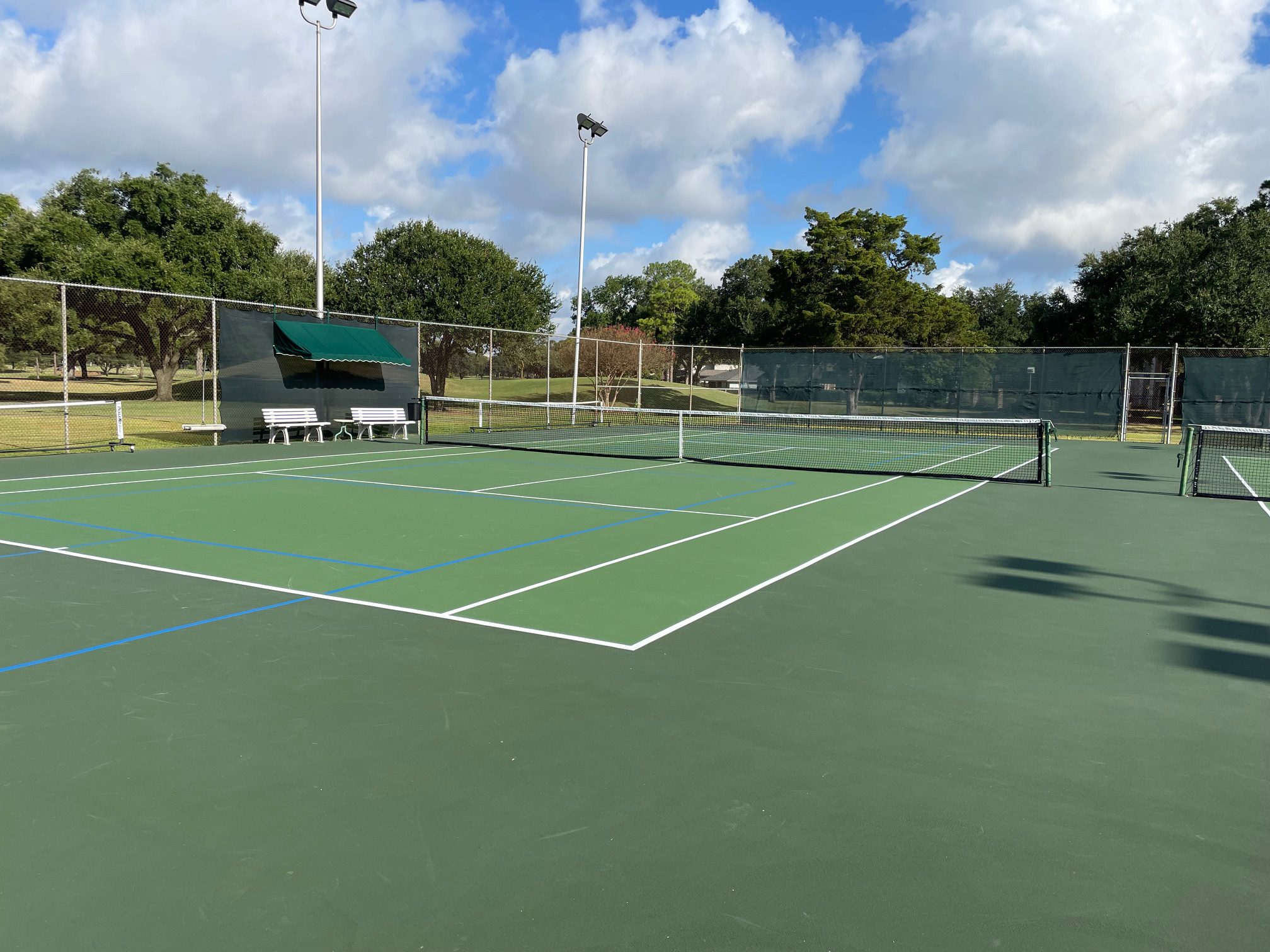
This is the least disruptive option. Contrasting pickleball lines are measured and painted over the existing tennis colors, and portable nets can be used when pickleball is played.
The tradeoff is visual complexity. Tennis and pickleball lines share the same surface, and players need to distinguish one layout from another during play.
The pickleball court repainting guide explains how surface wear, weather, and coating condition influence painting decisions.
How Should Line Colors Be Selected?
Pickleball lines should stand out from the tennis markings without disappearing into the court color.
Using two similar shades can make the conversion difficult to follow. Extremely bright lines may solve visibility issues but leave the court looking crowded. The color plan should balance clear play with a finished appearance that suits the property.
Accurate measurement matters as much as color. A small error in the kitchen, service boxes, centerlines, or baselines affects every game played on the court.
When Does a Conversion Need Full Resurfacing?
Resurfacing is usually worth considering when the existing coating is faded, slippery, peeling, heavily patched, or too worn to support a clean new layout.
It may also be the better choice when the owner wants to change the primary use from tennis to pickleball. A complete color system allows the new courts to look intentional rather than added later.
During resurfacing, crews can clean the pavement, repair eligible cracks, address minor low areas, prepare the existing coating, apply the selected surface system, and complete the new line plan.
Can Resurfacing Correct Every Problem?
No. Resurfacing renews the playing surface, but it does not rebuild an unstable base.
Widespread movement, major settlement, drainage failure, severe cracking, or deteriorated pavement may require deeper work. The court should be evaluated before a resurfacing scope is approved.
Quality & Heritage Court Services provides tennis court resurfacing for courts that need surface renewal before a new layout is installed.
Should the Conversion Use Permanent or Portable Nets?
Portable nets preserve flexibility. They can be rolled into place for pickleball and removed when the tennis layout is needed.
This approach works well for occasional play, schools, shared recreation areas, or properties testing demand before committing to a permanent configuration.
Dedicated net systems provide a more polished and dependable setup. Players do not need to move equipment, measure the center, or adjust the net before every game.
What Is Required for Permanent Net Posts?
Post sleeves and anchors need accurate locations outside the pickleball sidelines. Their installation may involve cutting into the existing pavement and building suitable foundations below it.
The work should be coordinated with the drainage direction, reinforcement, existing tennis posts, underground utilities, and future maintenance. Poorly placed sleeves can collect water or interrupt the finished surface.
For multi-court layouts, every net should align consistently so the facility looks planned and plays predictably.
Does the Tennis Net Work for Pickleball?
A tennis net and a pickleball net do not have the same regulation height at the posts.
A pickleball net should be 36 inches high at the sidelines and 34 inches at the center. A tennis net is higher at its posts, although both dip to 36 inches at the center.
Some casual conversions use the existing tennis net with adjustments. That can work for informal activity, but a dedicated pickleball net provides the correct height across the court.
Can One Pickleball Court Use the Existing Tennis Net Line?
Yes, a pickleball layout can sometimes be centered on the existing tennis net. The usable clearances and post arrangement still need to be checked.
This configuration can be practical for a residential conversion or a shared court where tennis remains important. It will not create the same capacity as several dedicated pickleball courts across the full enclosure.
How Should Divider Fencing Be Planned?
Divider fencing or netting keeps loose balls from rolling into neighboring games.
Without separation, players on several courts can spend more time retrieving balls than playing. The divider system should contain balls while preserving clear entrances and safe movement between courts.
Posts, bases, tensioning hardware, and gates must remain outside player runoff areas. A divider placed too close to a sideline can create a hazard even if the painted dimensions are accurate.
What Should Happen to the Existing Perimeter Fence?
The fence should be inspected for leaning posts, loose mesh, corrosion, damaged rails, sharp projections, and gates that no longer close properly.
New gate locations may be needed when one tennis entrance becomes several pickleball entrances. Commercial facilities may also require wider accessible routes and enough room for equipment or maintenance access.
The conversion is an opportunity to correct fence problems before the new surface is finished.
Will the Existing Lighting Work for Pickleball?
It may, but tennis lighting was designed around one larger playing area. A multi-court pickleball layout can shift the important areas between the original fixture patterns.
The converted courts should be checked for dark corners, glare, heavy shadows, uneven coverage, and light poles that interfere with movement or divider placement.
Why Does the New Layout Change the Lighting Plan?
Players on several smaller courts stand in different positions from players on one tennis court. A fixture arrangement that looked balanced for tennis may leave one pickleball baseline bright and another noticeably dim.
Additional fixtures, aiming adjustments, controls, or new poles may be needed. Electrical capacity and local rules should be reviewed before promising evening use.
Lighting work is easier to coordinate before the final surface and divider systems are installed.
How Does Drainage Affect a Conversion?
The original tennis court slope does not change when pickleball lines are painted.
That can be acceptable when the pavement drains correctly. Problems arise when existing low areas fall inside the new playing zones or when divider systems, new curbs, landscaping, or surrounding work interrupt the path of water.
Texas storms can place a large amount of water on the surface quickly. Drains, channels, fence bottoms, and discharge areas should remain clear after the conversion.
Should Drainage Be Repaired Before Resurfacing?
Yes. The source of recurring puddles should be investigated before the new coatings are installed.
Minor surface corrections may help eligible low areas. Larger settlement or an unsuitable slope can require more extensive work. Water approaching from outside the enclosure may need to be redirected before it reaches the pavement.
Fixing drainage after new lines, nets, and fencing are complete can disturb finished work and increase the total cost.
How Much Does a Tennis-to-Pickleball Conversion Cost?
The cost depends on how much of the existing facility can be reused.
Adding lines and using portable nets is the least involved approach. Full resurfacing, permanent net systems, divider fencing, gate changes, lighting improvements, drainage repairs, and structural pavement work raise the budget.
The number of pickleball courts matters too. Four courts need more lines, nets, dividers, access planning, and equipment than a single shared layout.
What Should a Conversion Estimate Include?
• Surface inspection: Cracks, low areas, joints, coatings, slope, and drainage.
• Preparation and repairs: Cleaning, patching, eligible crack treatment, and surface correction.
• New layout: Court count, dimensions, clearances, colors, and line placement.
• Equipment: Portable or permanent nets, posts, sleeves, anchors, and storage.
• Containment: Perimeter fence repairs, divider systems, gates, and windscreens.
• Supporting work: Lighting, electrical changes, drainage, accessibility, cleanup, and restoration.
Each proposal should state what remains unchanged and what the owner must arrange separately.
Do Permits or HOA Approvals Apply to a Conversion?
Painting new lines may not trigger the same review as building a new court, but additional work can require approval.
New light poles, electrical work, tall fencing, drainage systems, retaining walls, expanded pavement, or changed commercial use may involve local permits. Residential properties may also have HOA rules governing colors, lighting, fencing, noise, and operating hours.
Commercial conversions should consider accessibility, parking, emergency routes, occupancy, and the movement of players between courts.
When Should Approval Questions Be Resolved?
Approval questions should be resolved before the final layout and equipment plan are approved.
A gate, divider, light pole, or expanded surface may need to move after a code or HOA review. It is easier to adjust the plan before resurfacing begins than after materials and equipment have been ordered.
What Are the Most Common Questions About Tennis Court Conversions?
It may be possible within a full tennis enclosure, but the final number depends on pavement dimensions, runoff space, fencing, gates, light poles, divider systems, and safe circulation between courts.
Not always. Shared facilities can retain tennis lines and add pickleball markings in a contrasting color. A dedicated conversion may cover the old layout during resurfacing and install only the new pickleball lines.
It can support casual play when adjusted appropriately, but a dedicated pickleball net provides the correct height across the full width. Multiple pickleball courts normally require their own net systems.
Only when the existing coating or pavement condition calls for it. Fading, peeling, slippery areas, cracks, low spots, and extensive patching may make resurfacing the better option.
Possibly, depending on the cause and severity of the cracking. The foundation and drainage should be inspected first because new coatings and lines will not stabilize a moving base.
The schedule depends on repairs, resurfacing, curing, net systems, fencing, lighting, weather, and approvals. A line-only project is faster than a full renovation with permanent equipment and structural corrections.
Why Should You Choose Quality & Heritage Court Services?
Quality & Heritage Court Services evaluates the entire existing facility before recommending a conversion plan.
The Existing Court Comes First
Cracks, low areas, drainage, coatings, fencing, lights, net foundations, access, and available clearances are reviewed before new lines are added.
The Layout Is Planned Around Real Use
A private family court needs a different conversion from a school, residential community, club, municipality, or commercial facility. Court count, circulation, equipment, and supporting features should reflect the intended use.
Construction and Surfacing Stay Connected
Repairs, resurfacing, painting, net systems, fencing, lighting, drainage, and maintenance can be coordinated within one plan.
Texas Conditions Are Considered
Strong sunlight, heat, sudden rain, expansive soil, and long dry periods influence the condition of outdoor surfaces and the recommendations made for each conversion.
Ready to find out how many pickleball courts your existing tennis court can support? Contact our team for an on-site evaluation and conversion plan.