Overview
Basketball court dimensions are not the same at every level. NBA and NCAA courts measure 94 feet by 50 feet, most high school courts measure 84 feet by 50 feet, and FIBA courts measure 28 meters by 15 meters. Half-court and residential layouts can be smaller, but the hoop, free throw line, key, three-point line, and clear space around the boundaries still need to work together.
The right layout depends on who will use the court. A school may need competition markings, while a private home may need a practical half court. Quality & Heritage Court Services designs residential, school, community, and commercial basketball courts around the level of play, available space, and site conditions.
What Are the Official Basketball Court Dimensions?
The NBA, WNBA, and NCAA use a 94-foot court. High school basketball generally uses an 84-foot court. FIBA uses metric dimensions.
| Level of Play | Official Playing Area | Approximate Metric Size |
|---|---|---|
| NBA | 94 feet by 50 feet | 28.65 meters by 15.24 meters |
| WNBA | 94 feet by 50 feet | 28.65 meters by 15.24 meters |
| NCAA | 94 feet by 50 feet | 28.65 meters by 15.24 meters |
| High School | 84 feet by 50 feet | 25.60 meters by 15.24 meters |
| FIBA | 28 meters by 15 meters | About 91 feet 10 inches by 49 feet 3 inches |
These measurements cover the area inside the boundaries. They exclude surrounding clearance, benches, seating, fencing, and walkways.
How Large Is an NBA Basketball Court?
An NBA basketball court measures 94 feet long by 50 feet wide. The center line divides it into two 47-foot halves.
The NBA's official court rules include the following measurements:
• Court size: 94 feet by 50 feet
• Rim height: 10 feet
• Free throw line: 15 feet from the plane of the backboard
• Three-point arc: 23 feet 9 inches from the center of the basket at its longest point
• Corner three-point distance: 22 feet
• Free throw lane width: 16 feet
• Restricted area: 4-foot radius from the center of the basket
• Backboard: 6 feet wide by 3 feet 6 inches high
An NBA-size court also needs unobstructed space outside the painted boundaries. WNBA courts use the same 94-by-50-foot playing area and 10-foot rim height, but the WNBA three-point arc is 22 feet 1.75 inches. The striping plan must therefore match the intended league.
What Are NCAA Basketball Court Dimensions?
An NCAA basketball court measures 94 feet long by 50 feet wide. The overall playing area matches the NBA, but the lane and three-point markings are different.
Important NCAA measurements include:
• Court size: 94 feet by 50 feet
• Half-court length: 47 feet
• Rim height: 10 feet
• Free throw line: 15 feet from the plane of the backboard
• Three-point arc: 22 feet 1.75 inches
• Free throw lane width: 12 feet
• Center circle diameter: 12 feet
The current NCAA men's basketball playing rules include the official rulebook and full court diagram. College-level training courts can use NCAA markings on a half-court layout if there is enough width and depth for the complete arc.
What Are High School Basketball Court Dimensions?
A standard high school basketball court measures 84 feet long by 50 feet wide. It is 10 feet shorter than an NBA or NCAA court but uses the same 50-foot width.
Half of a high school court is 42 feet long by 50 feet wide when divided at the center line. This can provide a useful starting point for a large residential or school practice court.
Common high school measurements include:
• Court size: 84 feet by 50 feet
• Half-court length: 42 feet
• Rim height: 10 feet
• Free throw line: 15 feet from the plane of the backboard
• Three-point line: 19 feet 9 inches
• Free throw lane width: 12 feet
• Center circle diameter: 12 feet
The NFHS basketball court diagram should be used when a project needs current high school markings.
What Are FIBA Basketball Court Dimensions?
A FIBA basketball court measures 28 meters long by 15 meters wide. That equals approximately 91 feet 10 inches by 49 feet 3 inches.
Key FIBA measurements include:
• Court size: 28 meters by 15 meters
• Half-court length: 14 meters
• Rim height: 3.05 meters
• Three-point arc: 6.75 meters
• Corner three-point distance: 6.60 meters
• Free throw lane width: 4.90 meters
• Restricted area radius: 1.25 meters
• Line width: 50 millimeters
The FIBA Venue Guide states that the 28-by-15-meter inner court should be surrounded by a boundary area of at least 2 meters. That creates a minimum overall floor area of 32 meters by 19 meters for the field of play and surrounding boundary.
How Big Is a Half Basketball Court?
There is no single half-court dimension that applies to every project. A true half court is based on half the length of the selected full-court standard while retaining the complete width.
| Court Standard | Half-Court Playing Area |
|---|---|
| NBA, WNBA, or NCAA | 47 feet by 50 feet |
| High School | 42 feet by 50 feet |
| FIBA | 14 meters by 15 meters |
These sizes retain the full width of the selected three-point line but do not include clear space outside the boundaries. Residential half courts are often smaller. A 40-by-30-foot court can support shooting, ball handling, and one-on-one play, while a 45-by-35-foot court provides more movement and shooting space.
When a half court is reduced, its markings should be adjusted deliberately. Forcing a regulation arc into a narrow space can place the line too close to a fence or leave no usable room beyond the shot.
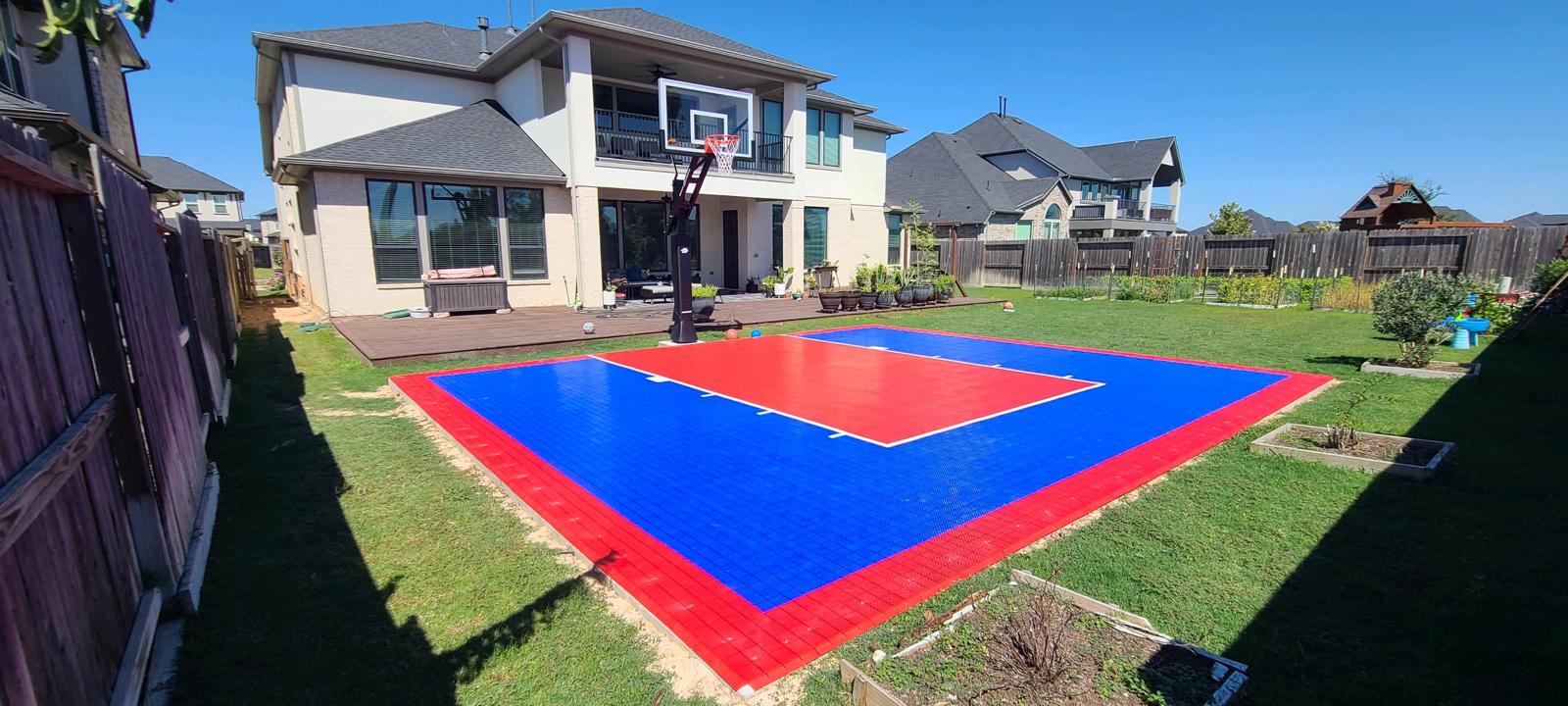
What Are Common Backyard Basketball Court Dimensions?
Backyard courts can be adapted to the property and intended use. These are planning examples, not official standards.
| Residential Layout | Common Planning Size | Suitable Uses |
|---|---|---|
| Large Regulation-Style Half Court | 47 feet by 50 feet | Full-width half-court play and realistic shooting positions |
| High School-Style Half Court | 42 feet by 50 feet | School-level training and half-court games |
| Large Custom Half Court | 45 feet by 35 feet | Shooting, drills, one-on-one, and small group play |
| Practical Home Court | 40 feet by 30 feet | Family games, practice, and one-on-one play |
| Compact Court | 30 feet by 25 feet | Layups, free throws, short shots, and drills |
| Shooting Court | 25 feet by 20 feet | Focused shooting and ball-handling practice |
A smaller purpose-built court can be more useful than a larger layout squeezed between obstacles. The hoop, baseline, primary shooting zone, and player run-off space should remain comfortable. If several activities share the surface, each line color should have a clear purpose.
How Far Is the Free Throw Line From the Basket?
The free throw line is 15 feet from the plane of the backboard under NBA, NCAA, and high school standards. The distance from the free throw line to the center of the rim is slightly different because the rim extends forward from the backboard.
Measuring 15 feet from the pole or the front of the rim will place the line incorrectly. The backboard position and rim projection must be established before striping. FIBA courts should be laid out directly from the current metric diagram.
How Far Is the Three-Point Line?
The three-point distance changes by level:
| Level | Three-Point Distance |
|---|---|
| NBA | 23 feet 9 inches at the arc and 22 feet in the corners |
| WNBA | 22 feet 1.75 inches at the arc, with shorter corner distances |
| NCAA | 22 feet 1.75 inches |
| High School | 19 feet 9 inches |
| FIBA | 6.75 meters at the arc and 6.60 meters in the corners |
The three-point line is measured from the center point directly below the basket. It is not measured from the backboard, hoop support, or baseline.
A court needs sufficient width for the selected arc and the area outside it. On a compact residential court, a high school line, shortened arc, partial arc, or selected shooting marks may be more useful than a professional-distance line that reaches the boundary.
What Are the Dimensions of the Basketball Key?
The key is the rectangular area extending from the end line to the free throw line. It is also called the free throw lane or paint.
The lane width changes according to the rule standard:
• NBA and WNBA lane: 16 feet wide
• NCAA lane: 12 feet wide
• High school lane: 12 feet wide
• FIBA lane: 4.90 meters wide
The selected key width affects the lane lines, free throw circle, player positions, and visual balance. A residential court can retain an official key even when the overall court is shorter, provided there is clear room for drives and rebounds.
What Is the Standard Basketball Hoop Height?
The standard rim height is 10 feet above the finished playing surface for NBA, WNBA, NCAA, high school, and FIBA basketball.
The height is measured from the top edge of the rim to the finished court surface. Adjustable hoops allow younger players to use a lower rim and return it to 10 feet as skills develop. Select the hoop before finalizing the slab and striping because the extension arm and footing affect baseline placement.
How Much Clear Space Is Needed Around a Basketball Court?
Players need unobstructed space beyond the marked court to land, slow down, and chase loose balls. The required clearance depends on the level of play and facility type, but boundaries should not sit directly beside rigid obstacles.
Keep run-off areas clear of:
• Walls and building corners
• Fence posts positioned beside a line
• Hoop supports in the player path
• Steps and sudden changes in elevation
• Pool coping and retaining wall edges
• Light poles
• Benches or outdoor furniture
• Drainage openings that can catch a foot
• Landscape borders and fixed equipment
Fencing, lighting, seating, walkways, and drainage structures belong outside the usable playing and run-off areas and must be included in the complete footprint.
How Much Space Is Needed for an Indoor Basketball Court?
An indoor facility needs more space than the marked court. In addition to the playing area and boundary clearance, the building must accommodate wall setbacks, structural columns, basketball equipment, lighting, ventilation, spectator areas, benches, storage, and circulation.
Ceiling height also matters. FIBA specifies at least 7 meters of unobstructed space above the field of play. A private indoor court may differ, but lights, beams, fans, ducts, and suspended equipment must remain clear of high shots and passes.
Before planning an indoor project, compare indoor and outdoor basketball courts. The playing dimensions are only one part of the complete facility plan.
How Should Basketball Court Dimensions Be Planned for Texas Properties?
Texas heat, rainfall, soil movement, drainage, access, setbacks, and impervious cover can all affect the usable footprint.
Soil and Foundation Conditions: Expansive soil can move as moisture changes. A stable court needs proper site preparation, drainage, and a foundation system suited to the property.
Drainage and Surface Slope: Outdoor courts need a controlled slope that prevents puddles and directs runoff away from buildings, pools, neighboring properties, and landscaping.
Setbacks, Easements, and Impervious Cover: Property lines, easements, setbacks, and limits on hard surface coverage can reduce the buildable area.
Sun and Court Orientation: Court orientation affects glare and comfort. Consider the hoop position in relation to the sun, trees, buildings, and expected playing hours.
Which Dimensions Are Best for Your Basketball Court?
Choose the dimensions according to the court's primary users and purpose.
A regulation full court works for organized games, team training, and facilities with enough room for two baskets and full transition play. A full-width half court works well for shooting, drills, and three-on-three games. A custom residential court can focus on the shots and movements players will use most often.
Before finalizing a size, answer these questions:
• Which age groups and competition levels will use the court?
• Is the priority full games, half-court play, shooting, or individual training?
• Which three-point line and lane width are needed?
• Will one hoop or two be installed?
• How much clear space is available beyond the boundaries?
• Is the court indoor or outdoor?
• Will fencing, lighting, seating, or multiple game lines be added?
• How will water leave the site?
• Are there setbacks, easements, HOA rules, or permit requirements?
The best court is the layout that preserves usable playing space, accurate markings, safe movement, and a practical relationship with the property.
Frequently Asked Questions About Basketball Court Dimensions
NBA, WNBA, and NCAA courts measure 94 feet by 50 feet. A standard high school court measures 84 feet by 50 feet. A FIBA court measures 28 meters by 15 meters, or approximately 91 feet 10 inches by 49 feet 3 inches.
Yes. NBA and NCAA courts both measure 94 feet by 50 feet. Their markings differ, including the three-point distance and lane width, so the selected rule standard must be confirmed before the court is striped.
Half of an NBA, WNBA, or NCAA court is 47 feet by 50 feet. Half of a high school court is 42 feet by 50 feet. A FIBA half court is 14 meters by 15 meters. Residential half courts are often made smaller to fit the property.
The free throw line is 15 feet from the plane of the backboard under NBA, NCAA, and high school standards. It should be positioned from the backboard reference point, not measured from the hoop support or front edge of the rim.
A regulation basketball rim is 10 feet above the finished playing surface. The same standard height is used by the NBA, WNBA, NCAA, high school basketball, and FIBA.
No. Official court dimensions refer to the marked playing area. Additional clear space is needed outside the boundaries for player movement, hoop supports, fencing, lighting, seating, walkways, and other facility features.